Skip to content

A pellet stove needs listed Type PL vent pipe, a double wall exhaust pipe with a stainless steel inner liner sold in 3 inch and 4 inch diameters, and in most Dallas and Fort Worth homes that installation runs $600 to $1,400 out through a side wall or $1,200 to $2,600 up through the roof. ALC Chimney Service cleans and inspects pellet venting starting at $99.99, which includes a Level 1 inspection. Three things move the number: how far the pipe travels to open air, how many elbows the route needs, and whether the stove ties into an existing masonry chimney or starts from a bare exterior wall. A single story utility room with a 3 foot wall pass-through sits at the bottom of that range, and a two story Frisco family room needing vertical pipe, roof flashing and a listed cap sits at the top.
What pellet stove venting work costs across the DFW metroplex:
- Horizontal through-the-wall installation, $600 to $1,400. Lap siding is a straightforward cut, while coring brick veneer on a 1990s Plano build takes longer.
- Vertical through-the-roof installation, $1,200 to $2,600. Climbs with roof pitch, story count and the number of firestop spacers the run needs.
- Three or four inch liner down an existing masonry chimney, $1,100 to $2,400. Flue height drives most of it, and an insulated liner costs more than a bare one.
- Annual pellet vent cleaning with a Level 1 inspection, $99.99 to $275. A short single run sits at the bottom. Heavy ash loading and multiple elbow breakdowns push it up.
- Horizontal termination cap replacement, $150 to $400. Varies with pipe brand and diameter, and with whether the wall thimble also needs redoing.
- Outside air kit, $150 to $350. Required on mobile home installations and worth it in tight post-2010 construction.
- Complete installation including the appliance, $3,500 to $6,500. The stove is most of that figure, and the venting route decides the rest.
The parts of a pellet venting system, in plain language:
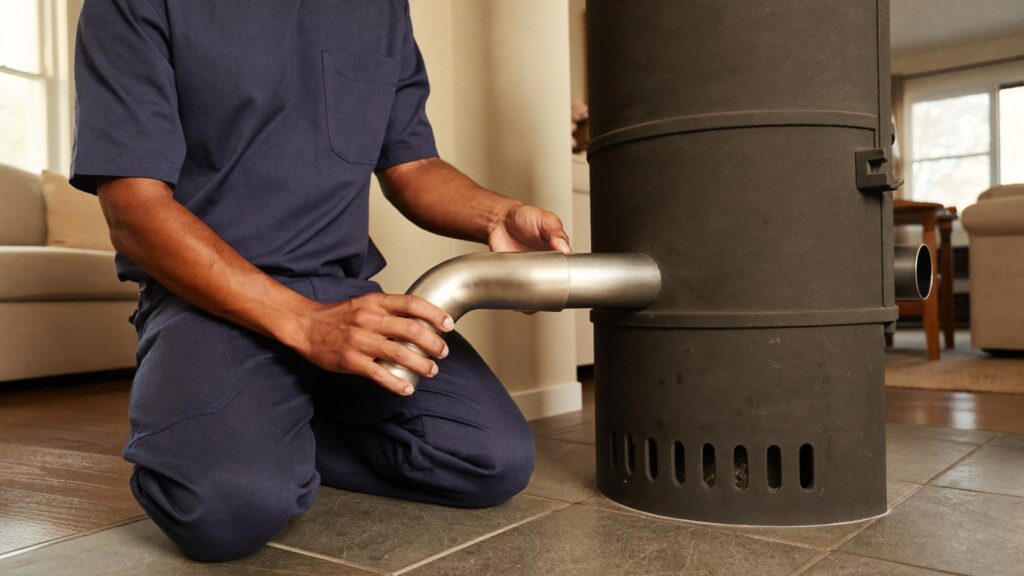
- PL vent pipe. Double wall exhaust pipe listed to UL 641 for pellet appliances, with a stainless inner wall and a painted outer shell, sold in 3 inch and 4 inch diameters.
- Combustion blower. The fan that pushes exhaust out under positive pressure, which is why pellet venting can run horizontally when a wood stove flue cannot.
- Heat exchanger. The tubes that carry heat from the fire into room air. Fly ash coats them and output drops while the fire still looks healthy.
- Fly ash. The fine grey powder pellet fuel leaves behind. It is not creosote, but it packs tight in elbows and turns corrosive once it picks up humidity.
- Wall thimble. The listed sleeve that carries the vent through a wall and holds the required air space to wood framing.
- Horizontal termination cap. The listed fitting at a side wall exit. It keeps rain and rodents out and directs exhaust away from the siding.
- Block-off plate. A sealed metal plate at the base of a masonry flue that closes the gap around a liner, so heated room air is not pulled up the chimney.
Treat every figure above as a starting point rather than a quote. Pellet venting is governed first by the appliance manufacturer’s installation instructions, which vary more between brands than homeowners expect. NFPA 211 and the pipe’s UL listing set the floor, and the manufacturer can be stricter. A CSIA-certified professional should look at the stove, the route and the wall assembly before anyone commits to a price. One warning about advertised pricing: a $59 vent cleaning coupon rarely covers a full system. It usually buys a vacuum at the stove and nothing past the first elbow.

Key Takeaways
- Pellet stoves require Type PL vent pipe listed to UL 641, not Class A chimney pipe and not single wall stovepipe. The wrong pipe voids the appliance listing.
- Most listed pellet vent needs 3 inches of clearance to combustible framing, though some brands are listed at 1 inch. The manufacturer’s instructions override the general rule.
- A side wall termination typically sits at least 12 inches above grade, 4 feet below or horizontally from any door, window or gravity air inlet, and 3 feet from a forced air intake.
- Three to five feet of vertical rise before the wall exit keeps smoke out of the room when power fails, which matters in a region that lost power in February 2021 and the 2023 ice storm.
- Pellet venting needs professional cleaning once per heating season, or every one to two tons of pellets burned, because fly ash builds faster at low burn settings.
- Expect $600 to $1,400 for a through-the-wall installation in DFW and $1,200 to $2,600 for a vertical run through the roof, with elbow count and story height driving that spread.
What kind of pipe does a pellet stove actually need?
Pellet appliances need vent listed as Type PL, stamped as pellet vent on the outer wall and tested to UL 641. It is double wall with an air space, a stainless inner liner that resists acidic condensate, and an outer shell cool enough to sit closer to framing than a wood stove flue could. Most residential stoves use 3 inch pipe, and larger units or long runs call for 4 inch.
The reason the pipe is specific is chemistry rather than heat. Pellet exhaust runs cooler than a wood fire, often 300 to 500 degrees at the stove collar, and cool exhaust meeting fly ash and humidity turns mildly acidic. It eats galvanized steel from the inside out, starting at the low point of a horizontal run. We have cut open improvised runs in older Garland and Mesquite homes where the pipe had pinholed through in one season. The system also has to be a single listed assembly, so mixing pipe from one brand with elbows from another is not permitted, and a chimney inspection records mixed brands as a finding.
Can I use Class A chimney pipe for a pellet stove?
Venting into an existing Class A chimney is permitted in some configurations with the correct adapter, but Class A cannot substitute for PL vent on a new run. It is built for much higher flue temperatures and has a larger diameter, so pellet exhaust slows, cools and drops its ash and moisture on the way up.
Is 3 inch or 4 inch pellet vent right for my stove?
The stove’s manual answers this, and the answer turns on total equivalent vent length. Most manufacturers count a 90 degree elbow as roughly 5 feet of straight pipe and a 45 as about 3 feet, so a run with three 90s and 12 feet of pipe calculates closer to 27 equivalent feet.
How far does pellet vent pipe have to be from anything combustible?
The general figure for listed PL vent is 3 inches, measured from the outer wall of the pipe to wood framing, drywall backing, insulation, cabinetry or anything else that burns. Some brands carry a 1 inch listing, but only that specific pipe earns it.
Clearance gets violated most often in two places. The first is a wall crossing with no listed thimble, where the hole is cut barely larger than the pipe and the outer shell ends up against a stud. The second is a chase built after the stove went in to hide the pipe, which buries the run in blown insulation. Both are common in finished bonus rooms and converted garages across Collin and Tarrant County.
What clearance does a wall pass-through need?
Use a listed wall thimble sized to the pipe, which holds the required air space through the full wall assembly. On brick veneer the core hole has to fit the thimble rather than the pipe alone, and the exterior joint gets high temperature sealant rather than ordinary caulk.
How close can the termination be to a window or door?
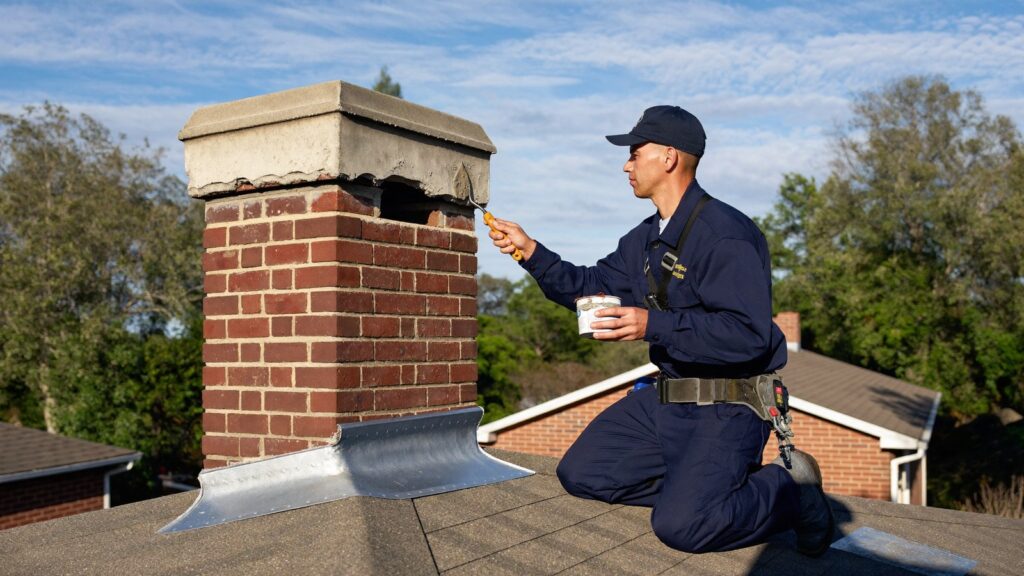
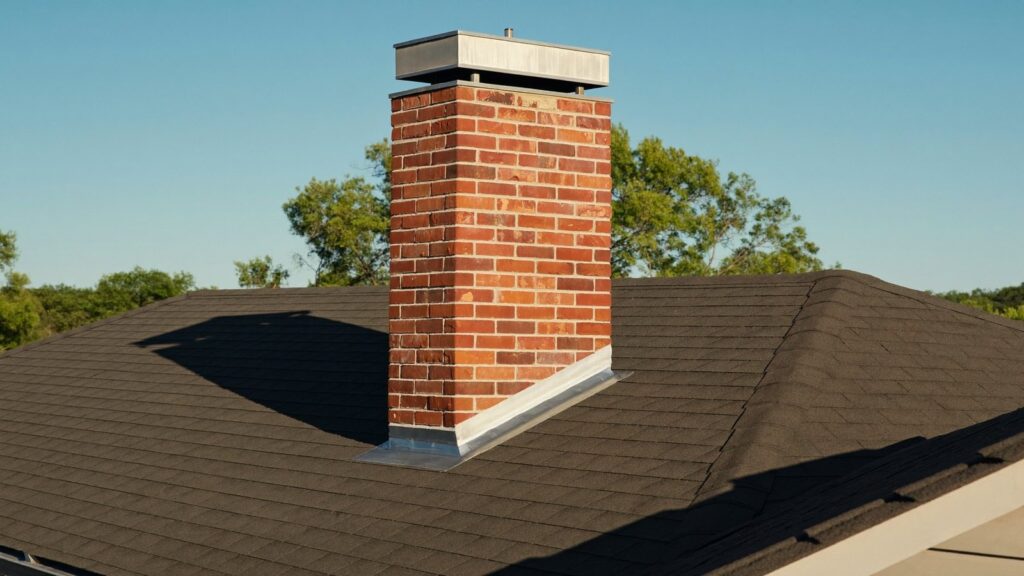
Typical listed requirements put it at least 12 inches above grade, 4 feet below or horizontally from any door, window or gravity air inlet, 3 feet from a forced air intake, and 2 feet from an adjacent combustible wall. Terminating under a patio cover or screened porch is not permitted. Spring hail and straight line wind, roughly March through June here, crush these caps regularly, so check yours after a storm, the same advice we give for chimney caps and crowns.
Can a pellet stove vent straight out through the wall?
Yes, and this is the main practical advantage of a pellet appliance. The combustion blower pushes exhaust out under positive pressure, so the system does not depend on hot gas rising through a tall flue. A short horizontal run through an exterior wall is a legitimate installation, which is why pellet stoves fit rooms where a wood stove never could, including Richardson and Irving ranch homes and garage conversions with no chimney at all.
A straight exit with no rise, while permitted under some listings, causes the most trouble later. Newer construction adds a second problem. A tightly sealed 2015 or later home in Frisco or Little Elm, running a 1,200 CFM range hood and two bath fans, can pull the house negative enough to interfere with a stove on a low setting. An outside air kit ducted to the combustion inlet fixes that for $150 to $350 installed.

Why do installers still add vertical rise?
Vertical rise gives the system passive draft to fall back on. Three to five feet of pipe going up before the horizontal section means that if the blower stops, hot gas still wants to climb and leave the building. Adding it during the original install is cheap, and retrofitting it later runs $500 to $1,200.
What happens during a power outage?
No power means no auger and no combustion blower, so the fire dies slowly while fuel in the burn pot keeps smoldering. With adequate rise that smoke exits on its own. Without it the smoke spills into the room, which is what many North Texas households learned during the February 2021 and early 2023 grid events.
How do I vent a pellet stove through an existing masonry chimney?
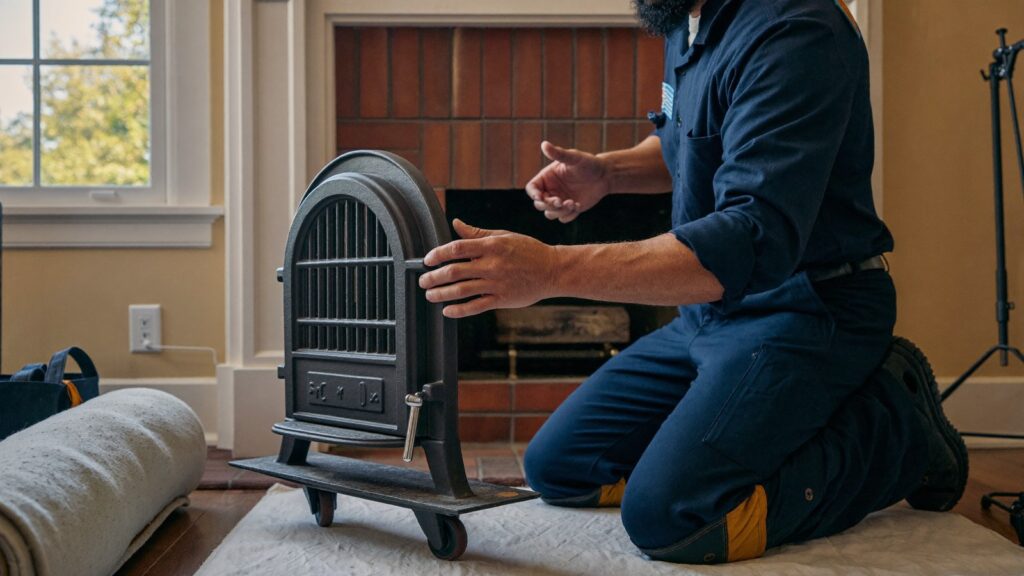
Plenty of DFW homes have a masonry fireplace that is barely used and an owner who wants a pellet insert or a freestanding stove on the hearth. That works well, with one condition. The exhaust has to travel inside a correctly sized liner running the full height of the flue rather than being dumped into the open flue itself.
An 8 by 12 inch clay flue has roughly ten times the cross sectional area of a 3 inch pellet vent. Put a small volume of cool exhaust into that much space and it stalls, cools further and drops moisture and ash the whole way up. Over a couple of seasons that means spalling firebrick, failing mortar joints and masonry chimney repair the flue did not need before. A 3 or 4 inch stainless liner solves it, usually insulated so flue gas stays warm enough to carry its moisture out, and our guide to chimney liner types covers the materials.
What is a block-off plate and why does it matter?
It is sheet metal cut to the fireplace throat and sealed around the liner, closing off the remaining flue space. Without one the chimney is an open hole from the room to the sky with a small pipe running through it, and your furnace spends the winter heating outdoor air. Any competent installation includes one.
How often does pellet stove venting need cleaning in North Texas?
Once per heating season at minimum, and more often if the stove carries a real share of the heating load. The usage rule most manufacturers publish is every one to two tons of pellets burned, which a household running the stove as primary heat through a cold January hits in one winter. Weekend-only use may take two or three seasons, but the annual inspection still matters, because ash sitting in a pipe all summer absorbs humidity and goes to work on the metal.
There is a quirk to pellet appliances in a mild climate that catches people out. Fly ash builds faster at low burn settings than at high ones, because combustion is less complete and exhaust velocity is lower. North Texas winters encourage exactly that pattern, with long shoulder seasons in November and March where the stove idles on setting one for weeks. Our annual chimney maintenance checklist covers the full seasonal rhythm.
Why does fly ash matter more than creosote here?
Pellet fuel is kiln dried to single digit moisture and burns hot and complete, so it produces very little creosote compared with cordwood. The problem is volume rather than flammability. The blower drives fine ash into every corner of the system, packing the outer radius of elbows and settling in the low point of any horizontal run until the stove faults out. Our piece on creosote buildup covers what wood burning does instead.
What does a professional pellet vent cleaning include?
The pipe comes apart. The technician disconnects the stove, breaks down each elbow, brushes and vacuums the full run, pulls and cleans the termination cap, cleans the heat exchanger and blower housing, then reassembles with the joints sealed, followed by a Level 1 inspection and a draft check. The Chimney Safety Institute of America sets the standard our technicians are certified against.
What does pellet stove venting cost in Dallas and Fort Worth?
The route is the price. A horizontal install through a framed exterior wall with one elbow, in a single story home with the stove against an outside wall, lands at $600 to $900 across most of the metroplex. Add brick veneer coring, a second elbow, or a stove on an interior wall needing 10 feet of pipe to reach daylight, and the same job becomes $1,000 to $1,400. Vertical through the roof starts around $1,200 and reaches $2,600 on a steep two story roofline. Cleaning is more predictable at $99.99 with a Level 1 inspection, or $189.99 for a double system.
What drives the price up on a two story roofline?
Height, pitch and access. A 12:12 pitch on a two story Prosper build means roof jacks, a second technician for safety, and more time at every step. The run needs a firestop spacer at each penetration, a support box, storm collar, flashing matched to the roofing material, and a listed vertical cap.
| Finding during inspection | What it leads to if ignored | Typical repair cost |
|---|---|---|
| Fly ash packed into the first elbow | Draft drops, the stove throws low airflow faults and shuts down mid cold snap | $150 to $275 cleaning |
| Single wall or galvanized stovepipe in place of listed PL vent | Acidic ash corrodes through the pipe and exhaust leaks into the wall cavity | $600 to $1,400 to replace the run |
| Termination cap crushed or missing after a hailstorm | Rain and rodents enter the vent and ash sets hard inside the pipe | $150 to $400 |
| No vertical rise before the side wall exit | Smoke spills into the room the moment grid power fails | $500 to $1,200 to add rise |
| Pellet exhaust vented into an oversized open masonry flue | Flue stays cold, moisture condenses, firebrick and mortar spall | $1,100 to $2,400 to line the flue |
| Termination under a patio cover or within 2 feet of a window | Exhaust re-enters the house and soot stains the brick | $600 to $1,500 to relocate |
Why Choose ALC Chimney Service for Pellet Stove Venting in DFW?
ALC Chimney Service is a family owned, CSIA-certified chimney company working across Dallas, Fort Worth and the surrounding metroplex. Our technicians carry more than 15 years of combined experience and we have completed more than 10,000 jobs across DFW, including pellet and wood stove venting on everything from 1960s ranch homes in Richardson to new construction in Prosper. We are licensed and insured, and our Google rating is 5.0 across more than 172 reviews.
Pricing is published rather than negotiated at the door. A sweep with a Level 1 inspection is $99.99, and $189.99 covers a double chimney. Repair inspections are free, so if you suspect your venting was installed wrong there is no charge to find out, and we add no trip fees anywhere in our service area. On a pellet venting call you get a technician who takes the run apart rather than vacuuming the first two feet.
Frequently Asked Questions
Does a pellet stove need a chimney at all?
Not a traditional chimney. Because the combustion blower pushes exhaust out under pressure, a pellet stove can vent through a short run of PL pipe out an exterior wall, which makes these appliances practical in rooms with no flue. You still need listed pipe, a thimble, correct clearances and a compliant termination.
How often should pellet stove venting be cleaned?
At least once per heating season, and ideally every one to two tons of pellets burned. A primary heat source reaches that threshold in one winter. Weekly maintenance of the ash pan and heat exchanger does not substitute, because none of it reaches the pipe, the elbows or the termination cap.
Do I need a permit to install pellet stove venting in Dallas or Fort Worth?
Most DFW municipalities require a mechanical permit for a solid fuel burning appliance and its venting, and requirements differ between Dallas, Fort Worth, Plano and the smaller Collin and Denton County cities. Check with your city’s building department before work starts, or have your installer pull it. A permitted install is also easier to defend on an insurance claim.
Can pellet vent pipe run through an existing masonry chimney?
Yes, and it is a good solution for a pellet insert or a hearth-mounted stove. The pipe has to run as a continuous 3 or 4 inch stainless liner the full height of the flue, usually insulated, with a sealed block-off plate at the bottom. Venting into the open masonry flue is not acceptable, because the flue volume is far too large.
Will a pellet stove still work in a power outage?
No. The auger that feeds pellets and the blower that moves exhaust both run on household electricity, so the stove shuts down when power is lost. Fuel already in the burn pot continues to smolder, which is why adequate vertical rise matters, since it lets that smoke leave the building passively.
Is pellet stove venting safe in a mobile home?
It can be, with specific additions. Manufactured home installations require an outside air kit ducted to the combustion inlet, the appliance anchored to the structure, the unit grounded to the chassis, and a stove listed for manufactured home use. Clearances are tighter than in site built homes, so check local code first.
If your pellet stove is throwing airflow faults or has venting you were never sure about, have it looked at before the first hard freeze rather than during one. A pellet vent cleaning with a Level 1 inspection is $99.99, $189.99 for a double system, and repair inspections are free. Call ALC Chimney Service at (877) 656-0851 or book an appointment online.
Find our chimney safety tips faster on Google