Skip to content

A complete annual chimney maintenance checklist for a North Texas home comes down to one professional visit a year plus four or five things you can check yourself between visits. The professional visit is a sweep and a Level 1 inspection, which ALC Chimney Service performs for $99.99 on a standard single chimney and $189.99 on a double. That visit covers the flue, firebox, damper, crown, cap and flashing. Your own between-visit checks cover what changes fast in this climate: water stains on the ceiling near the chase, rust streaks on the brick, a cap gone missing after a windstorm, and a damper that no longer swings freely. NFPA 211 asks for an annual inspection regardless of how much you burn, because most of what fails on a Dallas or Fort Worth chimney fails from weather rather than from fire.
What annual chimney maintenance actually costs in the DFW metroplex:
- Annual sweep plus Level 1 inspection, $99.99 at ALC for a standard single chimney and $189.99 for a double. The price moves with roof pitch, how the technician has to reach the stack, and how much buildup has accumulated since the last service.
- Level 2 inspection with a camera scan, $150 to $350. Required for a home sale, after a chimney fire, or after a fuel change. The range reflects how many flues are in the stack.
- Chimney cap supplied and installed, $150 to $450. A stainless single flue cap sits at the bottom. A custom multi flue cap for a wide stack on a two story Plano or Southlake home sits at the top.
- Crown repair, $150 to $400 for a sealant coat and $600 to $1,800 for a poured rebuild. A hairline crack takes a flexible coating, while a crown broken into pieces has to be recast.
- Flashing repair at the roofline, $250 to $700. Composition shingle is cheaper to work than tile, and the job costs more when counter flashing has to be cut back into the mortar joint properly.
- Heavy creosote removal, $250 to $600 on top of the sweep. This applies when glazed Stage 3 deposits need rotary tooling rather than a brush pass.
The chimney parts your technician will name during an annual service:
- Flue. The vertical passage inside the chimney that carries smoke and combustion gases out of the house.
- Liner. The protective lining of that passage, usually clay tile in older DFW homes or stainless steel in relined systems.
- Creosote. The tar like residue that condenses on flue walls when wood smoke cools. It is the fuel in a chimney fire.
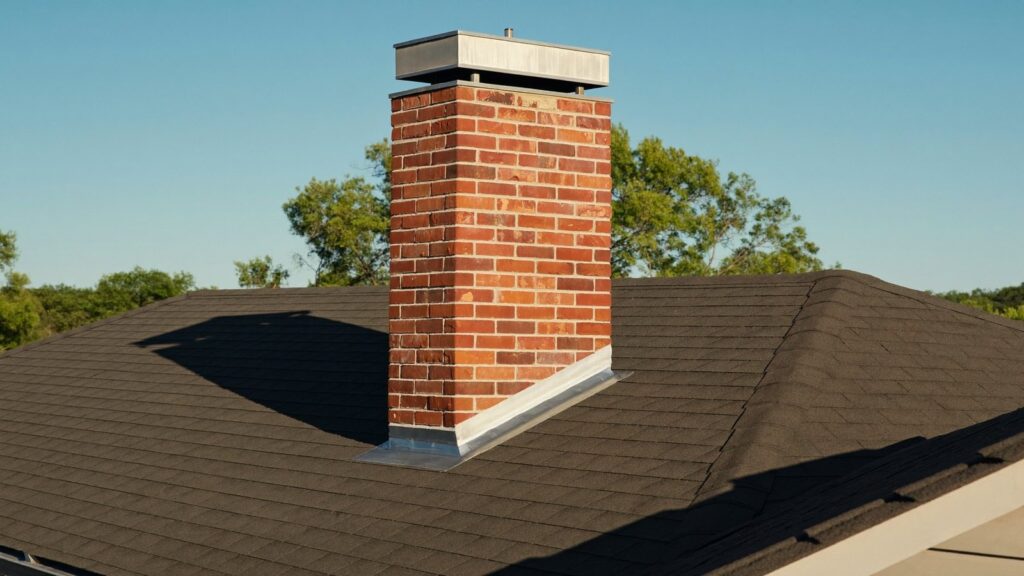
- Chimney crown. The sloped concrete slab across the top of a masonry chimney that sheds rain away from the brickwork.
- Chimney cap. The metal hood and screen above the flue opening that keeps rain, leaves and animals out while letting smoke escape.
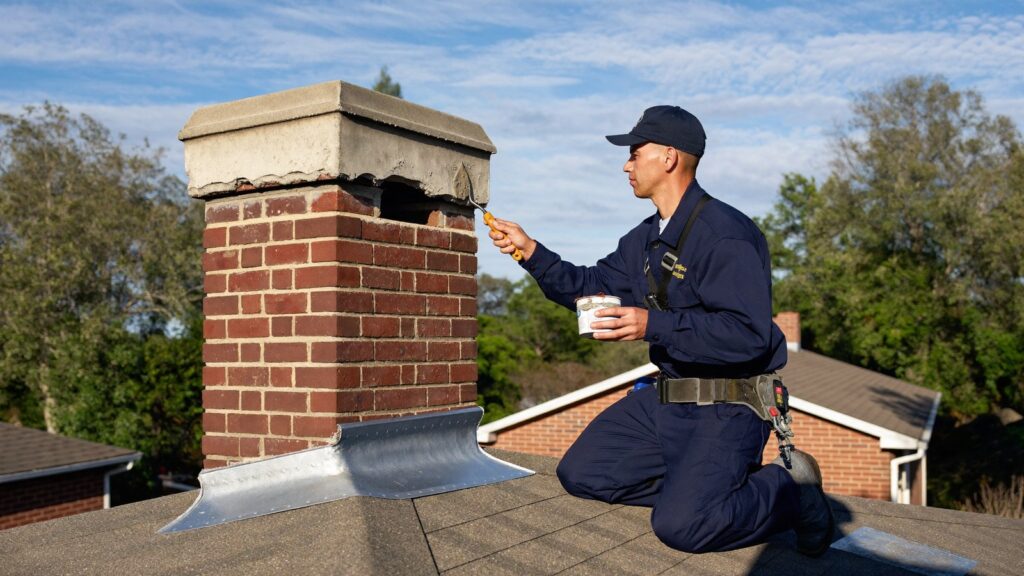
- Flashing. The layered metal weatherproofing where the chimney passes through the roof plane, and the most common source of chimney related ceiling leaks.
- Damper. The hinged plate above the firebox that opens for a fire and closes to stop conditioned air escaping up the flue.
- Smoke chamber. The tapered space between firebox and flue that funnels smoke upward. Rough or unparged chambers collect creosote quickly.
Treat every figure above as a starting point rather than a quote. Chimney pricing depends on what a technician finds once the damper is open and the camera goes up the flue, so have a CSIA certified professional look at the system before you commit to any repair scope. One warning worth taking seriously: a sweep advertised at $39 or $49 is almost never a real sweep. That price does not cover the labor, the drop cloths and the vacuum, so it exists to get a technician into the living room, at which point the conversation turns to several thousand dollars of work that may or may not be necessary.

Key Takeaways
- NFPA 211 calls for a chimney inspection once every year, whether or not you burned a fire last season.
- A sweep and Level 1 inspection at ALC runs $99.99 for a standard single chimney and $189.99 for a double, with no trip fee.
- CSIA sets the sweep threshold at one eighth of an inch of creosote, which many DFW homes reach in one active winter.
- Book between August and early October, because the November cold fronts fill the schedule and stretch lead times past two weeks.
- Water rather than fire causes most chimney damage in North Texas, and a cracked crown or failed flashing is what lets it in.
- A Level 2 inspection with a camera scan is required before a Texas home sale and after any chimney fire, at $150 to $350.
What should be on an annual chimney maintenance checklist?
The professional half is fixed by standard. A Level 1 inspection under NFPA 211 covers the readily accessible parts of the chimney and the appliance connected to it: firebox, damper assembly, smoke chamber, accessible flue, crown, cap and exterior masonry. A sweep removes creosote and soot from the flue walls and clears the smoke shelf. Both happen in the same visit, which is why ALC bundles them at $99.99.
The homeowner half of the checklist is about watching for change. Three or four times a year, look at the chimney from the yard for a cap that has shifted or disappeared, dark staining running down the brick, white chalky deposits that signal water moving through the masonry, and any brick face that has flaked off. Inside, open the damper and confirm it swings without forcing.
Keep a simple record of each service date, what the technician found and what was deferred. When you sell the house, that record shortens the conversation considerably, and it protects you if a buyer’s inspector flags something already documented and addressed.
How long does a full annual service take?
A standard sweep and Level 1 inspection on a single flue takes 45 to 90 minutes, depending on access and buildup. A double chimney runs closer to two hours. Add time when the technician has to set up safely on a steep two story roof.
What is the difference between a sweep and an inspection?
A sweep is cleaning and an inspection is assessment. A sweep with no inspection tells you the flue is clear but nothing about whether the liner is cracked or the crown is failing, and an inspection with no sweep leaves the creosote in place. Both belong in the same annual visit. Our guide to chimney inspection levels 1, 2 and 3 explains where each level applies.
When is the best time of year to schedule chimney maintenance in North Texas?
Late summer through early October. August and September are the quietest months in this trade, which means shorter lead times and a technician with time to walk you through what he found instead of rushing to the next call. By the second week of November, after the first real cold front pushes through Dallas and Tarrant County, every reputable company in the metroplex is booked out.

There is a practical reason beyond convenience. If the inspection turns up a cracked crown, a failed liner or flashing that has pulled away from the brick, you want that repair scheduled before you need the fireplace. Repair work in August happens on a normal schedule, while the same repair in December competes with everyone else’s emergency.
Can I still book in December?
Yes, though expect a longer wait and less flexibility on timing. If you are calling in December because you smell smoke in the room or see water coming down the chase, say so clearly when you call, because that changes how the visit is prioritized.
Does a gas fireplace need annual service too?
It does, and homeowners skip it constantly because a gas log set produces no visible soot. Gas appliances still vent combustion byproducts whose moisture is corrosive to clay liners and metal chase covers, and gas flues block with bird nests and debris exactly like wood burning ones. A blocked gas flue puts carbon monoxide into the house rather than up the stack.
How often does a North Texas chimney actually need sweeping?
The inspection is annual without exception, while the sweep is condition based. A household that burns two or three fires a season on a gas log set may go two years between sweeps. A household in Flower Mound or Keller that burns oak three nights a week from November through February needs a sweep every year, and sometimes a mid season one.
What drives the difference is how completely the wood burns. Seasoned hardwood burning hot in a well drafting fireplace leaves very little behind, while damp wood or a fire damped down overnight produces smoke that cools and condenses into creosote on the flue walls. A lot of DFW chimneys run on an exterior wall, which keeps the flue colder and makes buildup worse than the same habits would cause in a centrally located stack.
What does the one eighth inch rule mean?
The Chimney Safety Institute of America sets one eighth of an inch of creosote accumulation, roughly two stacked quarters, as the point where a flue should be swept. A technician measures it during the inspection, which is why the annual visit matters even in a year you barely used the fireplace.
Do manufactured logs reduce creosote?
Some manufactured logs contain additives marketed as creosote reducers, and they do loosen deposits. They do not replace a sweep, because the loosened material still has to come out of the flue and usually ends up piled on the smoke shelf.
What should you check yourself between professional visits?
Homeowner checks are about early detection rather than repair. The most valuable thing you can do is notice a change and report it before it becomes structural, because water damage compounds quickly in this climate. A small crack that admits moisture in October becomes a spalled brick face after the first hard freeze in January.
Walk the perimeter after any significant storm. From the ground, with binoculars if the stack is tall, look at the cap, the crown edge and the line where the chimney meets the roof. Inside, check the ceiling and wall around the chase for staining, and the firebox for new cracks in the refractory panels.
What can I safely inspect from the ground?
Quite a lot. Missing or tilted caps, crown cracks on a shorter stack, spalled brick, white efflorescence staining, mortar joints that have opened up, and a chase cover starting to rust and pond water are all visible from the yard and all worth a phone call.
What should I never do myself?
Do not get on a roof to work on a chimney, and do not seal one with a hardware store masonry sealer. Most of those products trap moisture inside the brick rather than shedding it, so they accelerate the spalling they were bought to prevent. Waterproofing takes a vapor permeable product applied correctly, which is why masonry chimney repair and sealing belong with someone who does it daily.
Which parts of a DFW chimney fail first, and what does fixing them cost?
Almost every expensive chimney repair in North Texas starts as a cheap water problem. The chimney is the only part of the house that sticks straight up into the weather with masonry exposed on all four sides, and brick absorbs water. When that water gets behind the face and then freezes, it pushes the brick apart from the inside. The table below shows the findings that come up most often on annual inspections across the metroplex, what each one turns into when it is left alone, and the typical cost to address it while it is still small.
| Finding at annual inspection | What it leads to if ignored | Typical repair cost |
|---|---|---|
| Hairline cracks in the chimney crown | Water into the brick core, spalling faces, crown collapse | $150 to $400 sealed, $600 to $1,800 recast |
| Missing or rusted chimney cap | Rain down the flue, nest blockage, rusted damper | $150 to $450 installed |
| Failed or caulked over flashing | Ceiling stains, wet insulation, rotted roof framing | $250 to $700 |
| Stage 2 or Stage 3 creosote glaze | Chimney fire, cracked liner, smoke damage inside the home | $250 to $600 above the sweep |
| Cracked clay flue tiles | Combustion gases into the wall cavity, failed Level 2 | $2,500 to $5,500 stainless reline |
| Deteriorated mortar joints | Loose brick, leaning stack, structural repair | $400 to $1,200 tuckpointing |
| Warped or stuck damper | Heat loss year round, smoke spillage into the room | $250 to $600 |
Why do crowns crack so fast in Texas?
Thermal cycling. A dark masonry crown in Dallas can swing from 45 degrees at dawn to well over 130 degrees on its surface by mid afternoon in August, then drop again overnight. Mortar crowns poured thin by production builders in the 1990s were never reinforced to survive that cycle, and a January freeze into a crown that has already opened up accelerates the failure.
How does North Texas weather change the maintenance schedule?
This region punishes chimneys differently than the northern markets most chimney advice is written for. Freeze cycles here are short and sharp rather than long and steady, which is harder on masonry. A stack can go through freeze and thaw several times in a single week in January, and each cycle drives water a little deeper into the brick.
Storm exposure matters as much as cold. Collin, Denton and Tarrant Counties take serious hail most springs, and a hailstorm that leaves the roof looking fine can still dent a chase cover, crack a crown coating or knock a cap loose.
What does a hard freeze do to a chimney?
Water inside the brick expands roughly nine percent when it freezes, pushing the face outward until a layer flakes off. That is spalling, and it does not stop on its own, because each flaked face exposes more absorbent material to the next rain.
What about hail and wind season?
Inspect after the season rather than during it. A March through June storm run in DFW often produces damage that only shows up the following winter as a leak on the ceiling. An August inspection catches it while the insurance claim window is still realistic and leaves time to get a replacement chimney cap installed.
What does an annual chimney service cost in the DFW metroplex?
The honest range across the metroplex for a sweep with a Level 1 inspection runs roughly $120 to $250, depending on access and chimney type. ALC holds that at $99.99 for a standard single chimney and $189.99 for a double, with no trip fee in the service area.
What moves the number up is access and condition. A single story ranch in Garland with a short stack and a clean flue sits at the bottom. A two story home in Southlake with a steep composition roof, a tall exterior stack and two seasons of buildup takes longer and costs more. Repairs are quoted separately after the inspection, never bundled into the sweep price sight unseen. If you also want the firebox and hearth detailed, fireplace cleaning happens in the same visit.
Why are coupon sweeps under $60 a warning sign?
Run the arithmetic. A sweep involves a technician for an hour or more, a vehicle, drop cloths, a HEPA rated vacuum, brushes and rods, insurance and a licensed business behind it. Nobody covers that for $49, so those offers are lead generation that depends on finding several thousand dollars of repair work once the technician is inside. The tell is a diagnosis delivered with urgency and no photographs. Read what a professional chimney inspection should include before you book anything.
Why Choose ALC Chimney Service in Dallas and Fort Worth?
ALC Chimney Service is a family owned company working across the DFW metroplex, with CSIA certified technicians, full licensing and insurance, and more than 15 years of combined experience. The crew has completed more than 10,000 jobs across Dallas, Tarrant, Collin and Denton Counties, so the technician who shows up has almost certainly worked on your builder, your brick and your roof pitch before.
The company holds a 5.0 rating from more than 172 Google reviews. An annual sweep with a Level 1 inspection is $99.99 for a standard single chimney and $189.99 for a double. Repair inspections are free and there are no trip fees in the service area. Findings are documented with photographs, so you see the crown crack or the creosote glaze yourself.
Frequently Asked Questions
How often should a chimney be inspected in Texas?
Once a year, every year, under NFPA 211. That applies to wood burning fireplaces, gas log sets and inserts alike, including a year you never lit a fire. The inspection catches weather damage and blockages, which accumulate whether or not the fireplace gets used.
What is included in a $99.99 chimney sweep and inspection?
A full sweep of the flue and smoke shelf with a sealed vacuum and drop cloth protection, plus a Level 1 inspection covering the firebox, damper, smoke chamber, accessible flue, crown, cap and exterior masonry, with findings documented in photographs. A double chimney is $189.99.
Can I do my own chimney maintenance checklist without a professional?
You can handle the observation half. Checking for ceiling stains, watching the cap and crown from the ground after storms, testing that the damper moves freely and keeping a service record are all reasonable homeowner tasks. Sweeping the flue, assessing the liner and any work on the roof belong with a CSIA certified technician.
How do I know if my chimney needs sweeping right now?
Common signs are a strong smoky smell when the fireplace is cold, smoke pushing back into the room, black flakes falling into the firebox, and a tar like coating on the damper. If you can scrape a deposit thicker than two stacked quarters off the flue, it is past due.
Does homeowners insurance cover chimney repair in Texas?
It depends on cause. Sudden damage from a storm, a lightning strike or a chimney fire is often covered, while deterioration from age, neglect or long term water infiltration usually is not, because insurers treat that as a maintenance failure. This is a practical reason to keep dated inspection records.
Do I need a Level 2 inspection to sell my house?
In practice, yes. A Level 2 inspection with an internal camera scan is the standard when a property changes hands, and most Texas buyers’ inspectors call for one if the home has a fireplace. It costs $150 to $350 and prevents a late renegotiation over a liner nobody had looked at.
Is an annual chimney inspection required by law in Texas?
There is no statewide statute requiring a homeowner to have one done. NFPA 211 is the consensus safety standard rather than a criminal code, though it is what insurers, home inspectors and courts reference after a fire. Some municipalities and most real estate transactions effectively require one, and homeowner policies increasingly ask about it.
Booking the annual visit before the first cold front is the easiest thing on this list to get right, and the one most North Texas homeowners put off until December. ALC Chimney Service covers a sweep plus a Level 1 inspection at $99.99 for a standard single chimney and $189.99 for a double, with free repair inspections and no trip fees. Call (877) 656-0851 or book through our contact page while the schedule is still open.
Find our chimney safety tips faster on Google