Skip to content

A standard chimney sweep in Mansfield, TX runs $99.99 for a single flue at ALC Chimney Service, and that price includes a Level 1 inspection rather than selling it back to you as an add-on. A house with two flues, common in the larger builds off Debbie Lane and Matlock Road, is $189.99. Most appointments take 60 to 90 minutes from the moment the drop cloths go down to the walkthrough of the photos at the end. What moves the number is the kind of system you own, how much creosote has collected in the flue, and how the technician reaches the top. Mansfield filled in quickly after the mid 1990s, so most fireplaces in town are factory-built metal units inside a framed chase rather than full masonry stacks, and that single fact changes the tools used, the parts that fail first, and what a technician spends the visit looking at.
What chimney work typically costs in Mansfield and southern Tarrant County:
- Chimney sweep with a Level 1 inspection, $99.99 for one flue and $189.99 for a double chimney. The double price covers homes with a second flue serving a gas log set, a second fireplace, or a wood stove, since each flue has to be brushed and inspected separately.
- Chase cover replacement, roughly $450 to $1,200. The spread comes down to the size of the chase and the metal chosen, since stainless costs more up front than the galvanized sheet most builders used and lasts several times as long.
- Chimney cap or rain pan, roughly $150 to $450. A single-flue stainless cap sits at the low end, while a custom multi-flue cap fabricated to fit an odd opening lands at the top.
- Flashing repair where the chimney meets the roof, roughly $350 to $900. Price tracks the pitch, the height, and whether the leak has already soaked the decking underneath.
- Refractory panel replacement in a factory-built firebox, roughly $250 to $700 per panel. It depends on the make and model and whether the listed replacement part is still manufactured, the catch on units past about twenty years.
- Glazed creosote removal, roughly $400 to $900. A standard sweep handles soot and flaky deposits, while hard tar-like glaze needs a rotary head or a chemical treatment on a second visit.
The parts of a Mansfield chimney, in plain language:
- Flue. The passage the smoke travels through. In an older masonry chimney it is a stack of clay tiles, and in a newer Mansfield home it is usually a double or triple-wall metal pipe.
- Chase. The framed, wood-built box, finished in siding or brick veneer, that encloses a factory-built chimney. It looks like masonry from the street and is not.
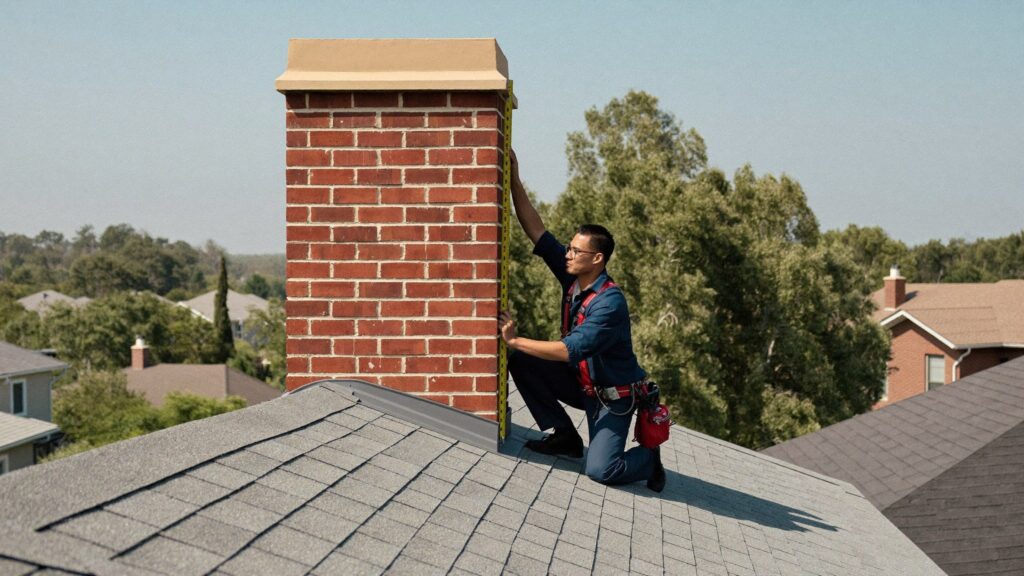
- Chase cover. The flat sheet-metal lid on top of that chase, with a hole for the flue to pass through. It carries all the rain the chimney sees and is the most common failure point on homes built here after 1990.
- Chimney cap. The hood and screen over the flue opening itself, which keeps rain, leaves and animals out and keeps embers off a neighbor’s roof.
- Creosote. The condensed residue of wood smoke coating the inside of the flue. It builds in three stages, from dusty soot to a flaky crust to a hard black glaze, and all three are flammable.
- Refractory panels. The hard, light-colored boards lining a factory-built firebox. They are the heat shield between the fire and the framing behind the wall, and wide cracks take the unit out of service.
Treat every figure above as a starting point rather than a quote. Chimney pricing in North Texas moves with access, the roofline, the condition of the masonry or chase, and what turns up once the cap comes off, so an honest number comes after a CSIA-certified technician has looked at the system. One warning is worth more than it sounds: a $39 or $49 sweep coupon is almost never a sweep. It is a foot in the door, and the visit tends to end with a list of urgent repairs priced nothing like the coupon.

Key Takeaways
- A single-flue sweep with a Level 1 inspection is $99.99 in Mansfield, and a double chimney is $189.99, with the inspection included rather than billed on top.
- NFPA 211 calls for an inspection of the chimney and venting system at least once a year, independent of how much you burned.
- Most Mansfield fireplaces are factory-built metal units in a framed chase, since the bulk of the housing stock went up after 1995, and those cannot be relined with stainless the way a masonry chimney can.
- Rusted chase covers are the most common finding in this part of Tarrant County, and replacement runs roughly $450 to $1,200.
- Book between April and September. Lead times stretch from a few days in late spring to two or three weeks once the first cold front arrives in November.
- A quarter inch of creosote anywhere in the flue is the CSIA threshold for cleaning, and glazed creosote needs a separate treatment at roughly $400 to $900.
How much does a chimney sweep cost in Mansfield, TX?
The sweep is $99.99 for a single flue and $189.99 for a double, and that holds across Mansfield, Kennedale, Burleson and the rest of the southern Tarrant County service area with no trip fee. ALC publishes a flat number instead of a range because the work in a standard sweep does not vary much. The flue gets brushed end to end, the firebox and smoke chamber get vacuumed, the damper gets checked, and the technician documents the condition of the cap, the crown or chase cover, and the flashing.
Where homeowners get surprised is the gap between a sweep and a repair. If the technician finds a cracked refractory panel, a rusted-through chase cover or a separated flue joint, those are separate jobs with their own pricing, and a reputable company will show you photographs rather than describe the problem. On a chimney repair visit, ALC does not charge for the inspection that establishes what needs doing.
What makes the price go up?
Three things, mostly. A second flue, which doubles the brushing and the inspection. Heavy or glazed creosote, which a brush will not move. And difficult access, meaning a steep two-story roofline or a chimney that has to be worked entirely from inside because the pitch is unsafe to walk.
Is the Level 1 inspection really included?
Yes, and it should be. A sweep without an inspection is half a service, since the point of running a brush up the flue is that someone with a camera and a flashlight sees what the brush uncovers. A standalone chimney inspection at Level 1 covers the readily accessible parts of the system, and Level 2 adds the attic, crawlspace and a camera scan of the full flue.
Why does a Mansfield chimney sweep look different from one in older Fort Worth?
Because the houses are different. Drive through the older parts of Fort Worth or east Dallas and you find full masonry chimneys with clay tile liners, built on site, often before 1970. Mansfield’s growth curve is much later. The city went from a small town on FM 157 to a city of tens of thousands over roughly two decades, and the neighborhoods that came with that growth, the builds around Walnut Creek, Lowe’s Farm, South Pointe and the subdivisions off Broad Street, were overwhelmingly fitted with factory-built fireplaces.
A factory-built system is a sealed metal firebox with refractory panels, venting into a double or triple-wall metal pipe inside a framed chase wrapped in siding or brick veneer so it reads as masonry from the curb. It is tested and listed as a complete assembly, which is the part homeowners miss. Every component has to be the manufacturer’s listed part, so you cannot substitute a generic damper, drop a stainless liner down it the way you would in a masonry chimney, or mix pipe from one maker with a firebox from another.

How does the technician sweep a factory-built flue?
Usually with a polypropylene brush rather than the wire brush used on clay tile, because wire scores the inside of a metal flue and strips the galvanizing, starting the corrosion it was supposed to prevent. The technician works the brush through the full length of the pipe, vacuums the firebox under negative pressure so the soot goes into the machine instead of into your carpet, then inspects the refractory panels and the door gasket if the unit has one.
What fails first on these systems?
The chase cover, by a wide margin. Builders through the 1990s and 2000s routinely used thin galvanized sheet with little slope and a short lip, and after fifteen to twenty-five North Texas summers it holds water, rusts through at the seams, and drips into the chase. By the time a stain shows on the ceiling near the fireplace, the framing inside has been wet a while. Second is the chimney cap, which either rusts out or was never properly secured.
How often should a Mansfield fireplace be swept?
The inspection is annual, without exception. NFPA 211 is clear that chimneys, fireplaces and vents get inspected at least once a year for soundness, deposits and correct clearances, whether you burned forty fires last winter or none. A chimney that sat unused still collects nesting material, still rusts, and still shifts.
Whether it needs sweeping at that visit depends on what the inspection finds. The CSIA threshold is a quarter inch of creosote anywhere in the flue, and a household burning most weekends from December through February hits that in one to two seasons. A household lighting three fires a year at Christmas may go three or four years between sweeps and still need the annual inspection each of those years.
Does a gas fireplace need this too?
Yes, for different reasons. Gas does not produce meaningful creosote, but it produces water vapor and mildly acidic condensate that eats at clay tile and mortar joints, and gas log sets in this area are regularly found with blocked flues, failed dampers or spider webs in the burner ports. A gas appliance venting into a blocked flue is a carbon monoxide problem, which makes the annual check more important rather than less.
What actually happens during the appointment?
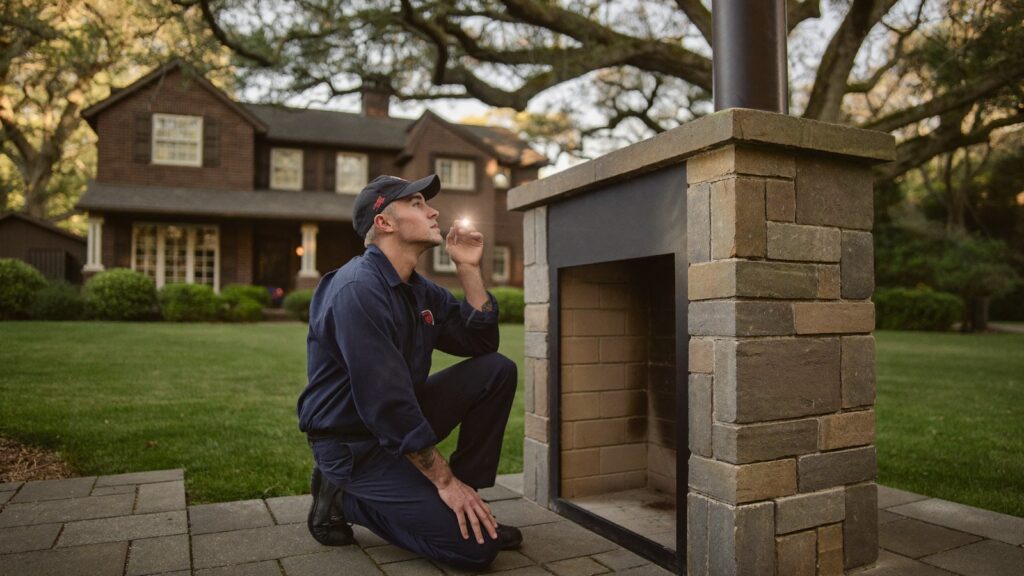
The technician lays drop cloths from the door to the hearth and sets up a HEPA vacuum at the firebox before touching anything. The flue is brushed through its full length, from the roof down or the firebox up depending on the system and the roof pitch. Soot and debris are vacuumed from the firebox and smoke chamber, the damper is cleared and tested, and the technician photographs the flue interior, the cap, the chase cover, the flashing and the firebox.
The visit ends with those photographs on a screen in front of you, and that is the part worth insisting on. A verbal report that your crown is cracked is a sales pitch. A photograph of the crack is information, and it lets you decide whether to do the work now, in spring, or not at all.
Do I need to do anything before the technician arrives?
Let the fireplace go cold for at least twenty-four hours, which is the one thing that can actually cancel an appointment. Clear a path to the hearth and move anything breakable off the mantel. You do not need to clean out the ash beforehand.
What problems come up most often on Mansfield homes?
The pattern is driven by weather and by age. Mansfield sits in the hail and wind corridor across southern Tarrant County, takes the same hard freezes the rest of North Texas gets, and much of its housing stock crossed the twenty-year mark recently, roughly when builder-grade chimney components start giving up together.
Water is behind most of it. Hail perforates chase covers and caps, wind-driven rain gets under loose flashing, and freeze and thaw cycles work moisture into masonry joints. None of these fail dramatically. They fail slowly, and the first symptom is usually a smell, a stain, or a draft. The creosote buildup problem gets the attention, and it deserves it, but water does more total damage to chimneys here than fire does.
| Common finding | What it leads to if ignored | Typical repair cost |
|---|---|---|
| Rusted or flat chase cover | Water runs into the framed chase, rots sheathing and studs, stains interior ceilings | $450 to $1,200 |
| Missing or damaged chimney cap | Rain in the flue, nesting birds and squirrels, embers on the roof | $150 to $450 |
| Cracked refractory panels | Heat reaches the framing behind the firebox, unit is unsafe to use until replaced | $250 to $700 per panel |
| Loose or caulked-over flashing | Leak at the roof line, damaged decking, drywall damage along the chimney chase | $350 to $900 |
| Glazed creosote in the flue | The highest-risk stage of creosote, hard to remove, a live chimney fire hazard | $400 to $900 |
| Spalling or cracked masonry crown | Water into the brick joints, freeze damage, eventual rebuild of the stack top | $300 to $1,400 |
| Damper rusted open or stuck shut | Conditioned air out all summer, or smoke in the room all winter | $250 to $650 |
When is the best time to book a chimney sweep in Mansfield?
Spring and summer, and the reason is scheduling rather than anything technical. From April through September a Mansfield appointment is usually available within a few days. From the first real cold front in November through the end of January, every chimney company in North Texas is booked out one to three weeks, and the week after the first hard freeze is the worst of it.
There is a practical argument too. If the inspection turns up a chase cover that needs replacing, scheduling it in June means it is done before storm season and well before you want a fire. Finding it in December means burning with a known defect or going without a fireplace through the coldest weeks of the year. Homeowners in nearby Arlington and Grand Prairie hit the same bottleneck.
What about after a storm?
Get it looked at, especially after hail. A chase cover that took a hail hit often looks fine from the ground and is perforated once you have a hand on it. If you are filing a roof claim, having the chimney documented at the same time is worth the call, since adjusters will not pay for something nobody recorded.
What a sweep does not include
A $99.99 sweep covers brushing and vacuuming the flue and firebox, checking the damper, and a Level 1 inspection with documentation. It does not include removing an animal or a nest, which is separate work and, for chimney swifts, restricted by federal law during nesting season. It also excludes glazed creosote removal, repairs, relining, a Level 2 camera scan, dryer vents and gas line work. For anything beyond maintenance, ALC’s chimney sweep service page and the locations directory lay out what is covered where.
Why Choose ALC Chimney Service in Mansfield?
ALC Chimney Service is a family owned company working across Dallas, Fort Worth and the surrounding metroplex, including Mansfield and the rest of southern Tarrant County. The technicians are CSIA certified, the company is licensed and insured, and the team brings more than 15 years of combined experience and better than 10,000 completed jobs across DFW, with a 5.0 Google rating from more than 172 reviews.
The pricing is published rather than quoted on the doorstep. A sweep with a Level 1 inspection is $99.99, a double chimney is $189.99, and a repair inspection is free. There are no trip fees anywhere in the service area, so the number you are told on the phone is the number on the invoice. Every visit ends with photographs of your own chimney and a written report, because a homeowner who can see the condition of their system makes better decisions than one taking a technician’s word for it.
Frequently Asked Questions
How long does a chimney sweep take in Mansfield?
Plan on 60 to 90 minutes for a single flue, including setup, the sweep, the Level 1 inspection and the walkthrough. A double chimney runs closer to two hours. Heavy creosote, a difficult roofline, or a system that has not been serviced in five years can push it longer, and the technician will say so before starting.
Will the sweep make a mess in my living room?
It should not. A proper sweep uses drop cloths from the entry to the hearth and a HEPA vacuum running at the firebox throughout, which holds the firebox under negative pressure so soot travels into the machine rather than the room. A company that shows up without dust containment is a reason to reschedule with someone else.
My chimney is a metal pipe inside a siding chase. Does it still need sweeping?
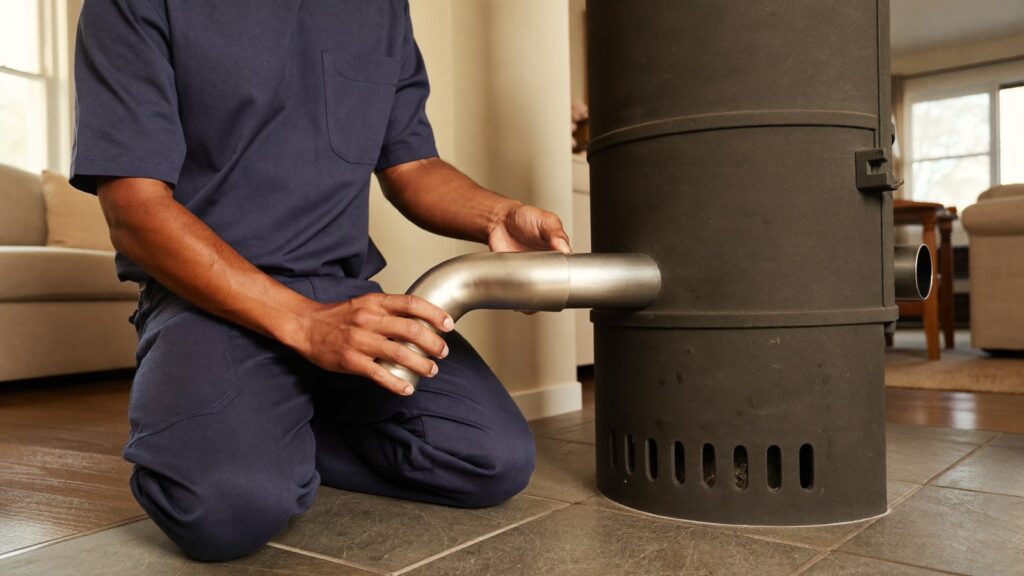
Yes. Factory-built systems collect creosote the same way masonry ones do, and they have their own failure points, especially the chase cover and the refractory panels. They need a polypropylene brush rather than a wire one, and every replacement part has to be the manufacturer’s listed component, so it matters that whoever services it knows the difference.
How do I know if I have a chimney fire risk right now?
You cannot tell from the living room, which is the honest answer. The signs worth acting on are a strong campfire smell when the fireplace is cold, a dense black glaze just above the damper, black flakes dropping into the firebox, or smoke pushing into a room from a fireplace that used to draft fine. Any of those earns a call before the next fire.
Can I sweep my own chimney with a kit from the hardware store?
You can brush a flue yourself, and plenty of people do. What a kit does not give you is the inspection that finds the cracked panel, the separated flue joint or the rusted chase cover. Knowing what you are looking at once the soot is gone is the half that matters, which is why NFPA 211 frames the annual requirement around inspection rather than cleaning.
What is the difference between a Level 1 and a Level 2 inspection?
Level 1 covers the readily accessible portions of the chimney and appliance, inside and out, and it is what comes with a standard sweep. Level 2 adds accessible attic and crawlspace areas plus a video scan of the entire flue interior, and it is required when a home changes hands, when the system or the fuel changes, or after an event such as a chimney fire. Level 3 means opening up concealed construction and is only done when a serious hazard is suspected.
If your fireplace has not been looked at this year, now is the easy time rather than the first cold week of November. A sweep with a Level 1 inspection is $99.99 for a single flue and $189.99 for a double, repair inspections are free, and there is no trip fee in Mansfield. Call ALC Chimney Service at (877) 656-0851 or request an appointment online.
Find our chimney safety tips faster on Google