Skip to content

A standard chimney sweep in Coppell costs $99.99 for a single flue, and that price includes a Level 1 inspection of the system while the technician is on site. A second flue on the same visit, common in the two-story homes off Parkway Boulevard that vent both a fireplace and a furnace, brings the total to $189.99. Both are flat prices inside the Coppell service area with no trip fee attached. What moves a job above the flat rate is condition rather than address: glazed third degree creosote, a rusted chase cover letting water into the framing, a cracked crown, or a prefabricated firebox with broken refractory panels. Most Coppell fireplaces are now 25 to 40 years old, so the sweep is often the first honest condition report the homeowner has ever had on the system.
What chimney work typically costs in Coppell:
- Standard sweep with Level 1 inspection, $99.99 per flue. Flat inside the service area, masonry or factory built, because the labor is comparable once the technician is set up.
- Double chimney or second flue on the same visit, $189.99. Cheaper than two appointments because the drop cloths, vacuum and ladder work are already staged.
- Heavy or glazed creosote removal, $250 to $450 per flue. Depends on how far the glazing runs and whether rotary tooling alone will lift it or a chemical modifier has to sit overnight.
- Chimney cap replacement, $275 to $650. Driven by flue count, single flue cap against a full multi-flue stainless top, and roof height.
- Chase cover replacement on a factory built chimney, $450 to $900. Stainless costs more than the galvanized original but stops the rust cycle restarting in eight years.
- Crown repair or rebuild, $350 to $900. A sealed hairline crack sits at the bottom of that range, a crown that has broken apart and taken brick courses with it at the top.
- Level 2 inspection with a camera scan, $189 to $350. Required for a home sale, after a chimney fire, and whenever a Level 1 finds something whose full extent is not visible by eye.
The parts of your chimney, in plain language:
- Flue. The vertical passage the smoke travels through, either clay tile inside a masonry chimney or a round metal pipe inside a factory built one.
- Creosote. The tar residue wood smoke leaves as it cools. It starts flaky, hardens into a crust, then becomes a shiny glaze that burns hot enough to crack a liner.
- Chimney cap. The screened metal lid over the flue opening, keeping rain, leaves and animals out and embers off the roof.
- Chase and chase cover. On a factory built fireplace the chase is the framed and sided box hiding the metal chimney pipe, and the chase cover is the flat metal lid on top. On most Coppell homes that lid is the first component to fail.
- Chimney crown. On a masonry chimney, the sloped concrete slab at the top that sheds water away from the brick. It is not the cap, and the two fail for different reasons.
- Damper. The plate that opens the flue for a fire and closes it to stop conditioned air escaping. Older throat dampers rust shut, while top sealing dampers mount at the flue opening instead.
- Firebox. The chamber the fire burns in, either firebrick and refractory mortar or, on a factory built unit, a steel shell lined with molded panels.
- Level 1 inspection. The baseline check defined in NFPA 211: readily accessible parts of the chimney and appliance, the flue interior, and the basic soundness of the structure and its connections.
Treat every figure above as a starting point rather than a quote. Chimney pricing turns on things nobody can see over the phone, including flue height, roof pitch, the number of offsets in the flue and how the last contractor left the system, so a CSIA-certified technician needs to look at it first. One warning worth taking seriously here: a $49 or $59 sweep advertised online is almost never a sweep, it is a sales appointment. The pattern is consistent, a technician arrives, spends ten minutes, and produces a four figure repair estimate for work the chimney may not need.

Key Takeaways
- A single flue sweep with a Level 1 inspection is $99.99 in Coppell, and a second flue on the same visit brings it to $189.99, with no trip fee inside the service area.
- NFPA 211 calls for an annual inspection of every chimney, fireplace and vent, regardless of how many fires were burned that year.
- Most of Coppell was built between 1985 and 2000, so a large share of the fireplaces are factory built units now 25 to 40 years old with original galvanized chase covers.
- Glazed third degree creosote is the condition that causes chimney fires. Removal runs $250 to $450 per flue against $2,500 or more to reline a flue damaged by a fire.
- Blackland prairie clay under Coppell shrinks and swells enough to pull a masonry chimney away from the wall, which shows up as stair step cracks in the mortar joints.
- Book between March and September, because the Coppell schedule tightens through October and usually runs two to three weeks out by the first cold snap in November.
How much does a chimney sweep cost in Coppell, TX?
The flat price is $99.99 for one flue, inspection included. That covers the sweep itself, containment so the house stays clean, and a Level 1 inspection with the findings explained before the technician leaves. Homeowners here often expect a tiered price list based on chimney height or neighborhood, and it does not work that way. A two-story in Riverchase and a single-story off Sandy Lake Road pay the same to have one flue swept.
Where the number changes is condition. Third degree creosote, meaning the shiny hardened glaze rather than loose soot, is a different job with different tooling at $250 to $450. If the chase cover has rusted through, the sweep is still $99.99 and the cover replacement is separate at $450 to $900. The sweep price is not a bait number that gets revised upward once the technician is on the roof. For how the individual services price out across the metroplex, the chimney sweep and cleaning service page breaks the work down by system type.
Are there trip fees for Coppell addresses?
No. Coppell sits inside the standard service area, so there is no travel charge, fuel surcharge or minimum job size. Homeowners near the Denton County line sometimes ask whether they are billed differently than the Dallas County side of town, and the answer is no.
What happens during a chimney sweep in Coppell?
The appointment starts inside, not on the roof. The technician lays canvas drop cloths across the hearth and the floor in front of it, seals the fireplace opening, and runs a HEPA vacuum at the firebox so the negative pressure keeps soot moving into the machine rather than into the living room. Only then does the brushing start.

Brushing runs the full length of the flue with rods and a brush head sized to that flue, plus rotary tooling where a straight brush cannot reach an offset. The smoke chamber and smoke shelf above the damper get cleaned by hand, because that is where the heaviest deposits collect and where a rushed sweep leaves the most behind. The damper is worked open and closed and lubricated if it binds, and the firebox is brushed and vacuumed last.
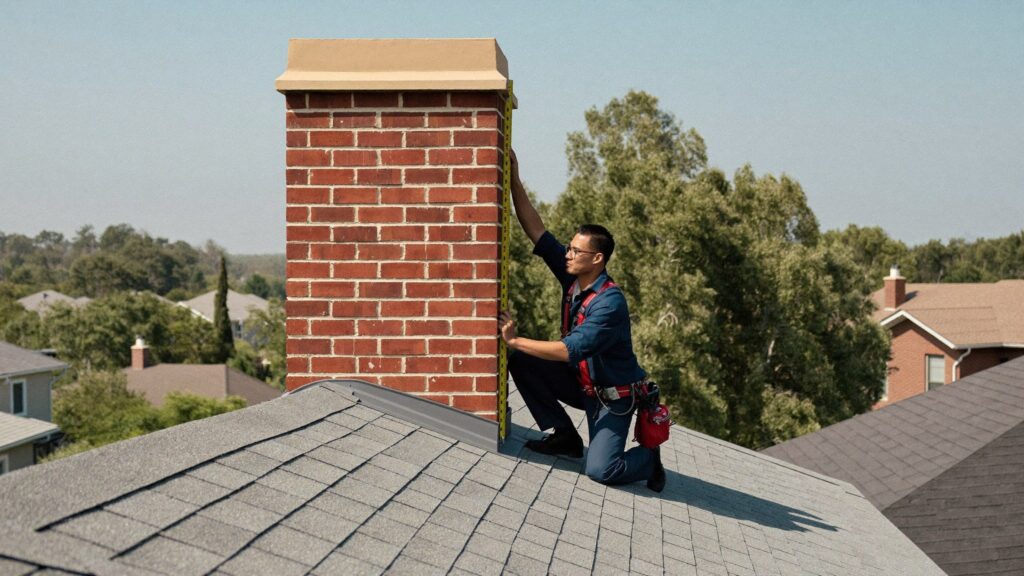
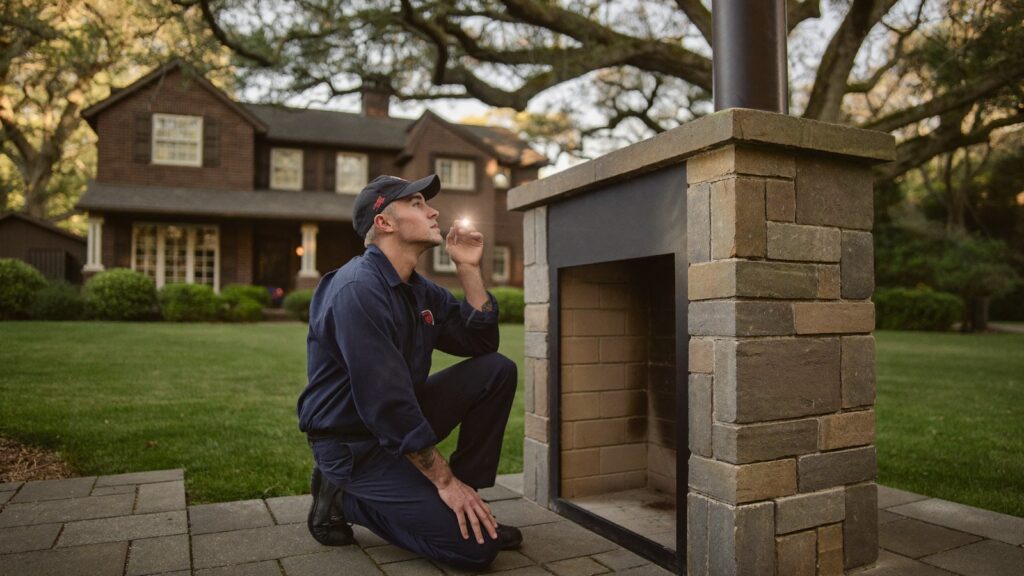
The inspection happens alongside the cleaning rather than as a separate visit. Once the flue is clean, the technician can actually see the liner, the crown or chase cover, the cap, the flashing where the chimney meets the roof, and the condition of the firebox. Findings get explained in plain terms, with photographs of anything that matters, before the drop cloths come up.
How long does the appointment take?
Plan on 45 to 90 minutes for a single flue in average condition. Heavy buildup, multiple offsets or a second flue pushes it toward two hours. A technician who is in and out in fifteen minutes did not clean the smoke chamber.
How often should a Coppell chimney be swept?
NFPA 211 calls for an annual inspection of every chimney, fireplace and vent. Sweeping happens when the inspection says it is needed, which for most Coppell households that burn wood a dozen or more times a season means every year. The standard separates the two on purpose, because a chimney can be structurally unsound while the flue is relatively clean, and the yearly look is what catches that.
The burning season here is short, running from late November through February around a handful of cold fronts, which tempts homeowners into stretching the interval to two or three years. The catch is that short, cool, smoldering fires lay down the worst creosote, and those are exactly the fires people burn in North Texas. Residue from twelve lazy evening fires in a leaky old prefab can be worse than a full winter of hot burns in a properly drafting masonry system. Our guide to creosote buildup and the stages it moves through covers what the technician is grading at the flue wall.
Does a gas log set still need a sweep?
It needs an annual inspection. Gas makes no creosote, but it does produce water vapor and mild acids that degrade clay tile and corrode metal, and gas installations frequently have a damper clamped open in ways that need checking. Debris and animal nests in a gas vented flue are a carbon monoxide problem rather than a fire problem, which makes the yearly look more important, not less.
Why do so many Coppell homes have prefabricated fireplaces?
Timing. Coppell went from a small town to a built out suburb between the mid 1980s and 2000, and factory built fireplaces were the standard specification for production builders through that whole window. The Lakes of Coppell, Northlake Woodlands and the developments along Denton Tap Road are full of them, and a homeowner who assumes their brick chimney is solid masonry is often surprised that the brick is a veneer over a framed chase with a metal pipe inside.
The distinction matters because the two systems fail differently. Masonry fails slowly through mortar and brick, while a factory built chimney fails at its manufactured parts, which have service lives. Original galvanized chase covers begin rusting through at roughly 15 to 25 years in this climate, which puts nearly every untouched Coppell chase cover past due. Once that lid goes, water runs down the outside of the flue pipe into the chase, rusts the firebox shell from behind, and surfaces as a ceiling stain long after the real damage started. A stainless replacement at $450 to $900 is far cheaper than the alternative. Old Town Coppell and the older properties near Bethel Road are the exception, with genuine masonry that predates the boom. For the full local picture, see the Coppell chimney services page.
How is sweeping a prefab different from a masonry chimney?
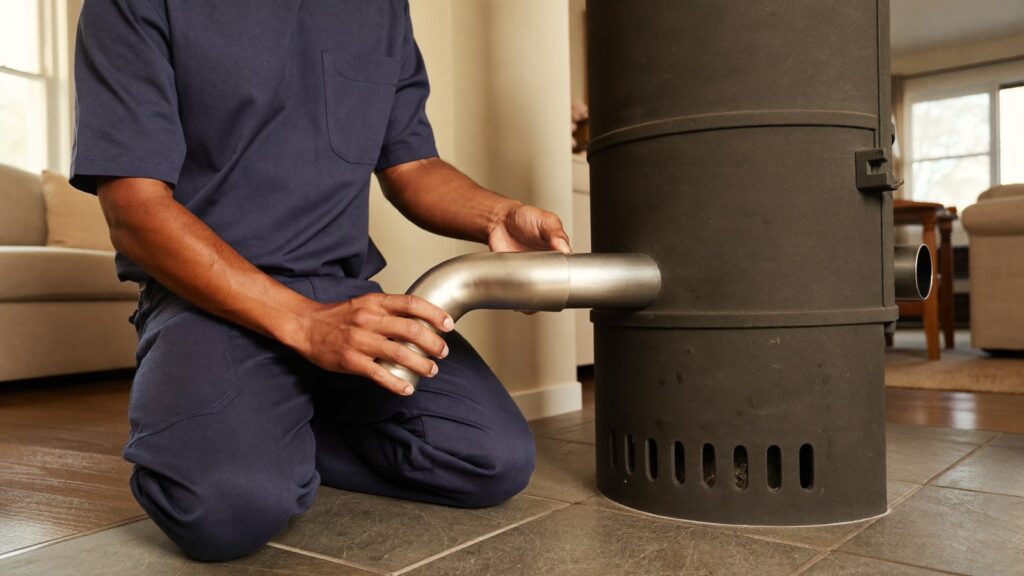
Tooling and care. A metal flue pipe can be scored by aggressive wire brushing, so factory built systems get poly brushes sized exactly to the pipe, and the refractory panels in the firebox are brittle. The inspection shifts focus too, away from mortar and tile and toward panel cracks, gasket condition, the chase cover, and whether parts installed over the years are actually listed for that unit.
Can a prefab firebox be repaired or does it need replacing?
Often repaired. Cracked or crumbling refractory panels can usually be swapped for $350 to $850 depending on the model and panel availability. What cannot be repaired is a steel shell that has rusted through or warped from a flue fire, or a unit whose parts are no longer manufactured, and any contractor offering to patch a compromised shell is not doing you a favor.
What chimney problems show up most often in Coppell?
Water intrusion leads by a wide margin, and it almost always traces to one of four components: a rusted chase cover, a missing or damaged cap, a cracked crown, or failed flashing at the roofline. North Texas rain arrives hard and sideways, so a gap that would shed water in a gentler climate takes on volume here. Second most common is creosote in the second or third degree in homes that have gone several seasons without service.
Third is a group of problems that come from the ground rather than the sky. Coppell sits on Blackland prairie clay, the expansive soil that cracks driveways across the metroplex. A masonry chimney is a heavy, narrow column on its own footing, so it moves on a different schedule than the house, and over a decade or two that shows up as stair step cracks through the mortar joints, a gap where the chimney meets the siding, or a chimney out of plumb. Hairline separation is monitored, while a leaning chimney or cracked flue tiles behind the movement is a safety issue, and the chimney inspection service is where that gets properly graded. The same patterns run through neighboring Carrollton and Grapevine, which were built out in the same years on the same soil.
What does hail do to a chimney?
More than most homeowners expect. Hail dents and punctures thin galvanized chase covers and crushes cap screening, and wind driven hail breaks the flashing seal at the roofline. None of it is visible from the ground, so storm damage routinely goes unnoticed until it surfaces as an interior stain. A cap and chase cover assessment after a significant hail event is worth doing, and often worth documenting alongside a roof claim.
What does a sweep not cover, and when do you need more than a Level 1?
A sweep with a Level 1 inspection covers what is readily accessible: the flue interior, the firebox, the damper, the visible exterior of the chimney and the connections. It does not include opening walls or ceilings, pulling out an insert or appliance, or a camera scan of the full flue length. Those are Level 2 and Level 3 territory, and NFPA 211 is specific about when each applies.
A Level 2 inspection, which runs $189 to $350 and includes a video scan of the flue, is required on a property transfer, after any event that could have damaged the chimney, and whenever the system or the appliance it serves is changed. It is also the right call when a Level 1 finds something whose extent is not visible, a cracked tile at the first bend being the common example. A Level 3 is the invasive one, involving removal of part of the structure to reach a concealed area, and it happens only when a serious hazard is suspected and cannot be confirmed any other way.
When is a Level 2 inspection required?
On sale or transfer of the property, after a chimney fire or a storm event that could have damaged the system, and whenever the appliance or the flue is changed, including adding a wood stove insert or converting from wood to gas. Coppell homes change hands often enough that the real estate driven Level 2 is a steady part of the work here.
| Finding at inspection | What it leads to if ignored | Typical repair cost |
|---|---|---|
| Glazed third degree creosote | Chimney fire that can crack clay tile or warp a metal flue | $250 to $450 to remove, $2,500 to $6,500 to reline after a fire |
| Rusted galvanized chase cover | Water into the chase, rusted firebox shell, ceiling stains | $450 to $900 for a stainless replacement |
| Missing or crushed chimney cap | Rain, leaves and animals in the flue, embers on the roof | $275 to $650 |
| Cracked chimney crown | Freeze and thaw spalling of the top brick courses | $350 to $900 |
| Failed flashing at the roofline | Ceiling and wall staining, rotted roof decking | $450 to $1,200 |
| Cracked refractory panels in a prefab firebox | Heat reaching the steel shell, unit taken out of service | $350 to $850 |
| Stair step cracks from soil movement | Chimney separation from the wall, cracked flue tiles | $1,200 to $6,500 depending on how much is rebuilt |
Why Choose ALC Chimney Service in Coppell?
ALC Chimney Service is a family owned, CSIA-certified, licensed and insured chimney company working across Dallas and Fort Worth. The team brings more than 15 years of combined experience and has completed more than 10,000 jobs across DFW, with a 5.0 rating from 172 or more Google reviews.
Pricing is published rather than quoted on the doorstep: $99.99 for a chimney sweep with a Level 1 inspection, $189.99 for a double chimney, and a free inspection when you are dealing with a repair. There are no trip fees inside the service area, which covers all of Coppell from Old Town to the Denton County line.
What matters most on a 30-year-old factory built system is whether the technician knows the difference between a part that has reached the end of its service life and a part somebody wants to sell you. That is the standard here. If the chimney is fine, the report says the chimney is fine.
Frequently Asked Questions
Do you serve all of Coppell?
Yes, the whole city, including Riverchase, The Lakes of Coppell, Northlake Woodlands, Magnolia Park, Old Town Coppell, and the newer sections near Parkway Boulevard and Denton Tap Road. Coppell is inside the standard service area, so no part of the city carries a trip charge or a travel minimum.
What is included in the $99.99 chimney sweep?
Full containment of the work area, brushing of the flue from the firebox through the smoke chamber and smoke shelf, HEPA vacuuming, a check and lubrication of the damper, and a Level 1 inspection of the readily accessible parts of the system as defined in NFPA 211. Findings are explained before the technician leaves, with photographs of anything that needs attention.
How do I know whether my fireplace is masonry or prefabricated?
Look inside the firebox. Real masonry is firebrick laid in mortar joints, usually with a brick or tile back wall. A factory built unit has smooth molded refractory panels, a visible metal frame around the opening, and often a manufacturer’s label plate inside the firebox. If you see a metal seam, it is a prefab.
Do you sweep chimneys that have gas logs installed?
Yes. Gas log sets do not build creosote, but the flue still needs the annual inspection for debris, animal nests, tile deterioration and damper condition. Any creosote left from years of wood burning before the logs went in still needs removing.
Is a chimney inspection required before selling a home in Coppell?
The state does not mandate it, but NFPA 211 calls for a Level 2 inspection on transfer of the property, and buyer’s inspectors flag chimneys often enough that most sellers are better off knowing first. A Level 2 with a camera scan runs $189 to $350 and gives you a document rather than a negotiation.
How soon can you get to a Coppell address?
Between March and September, usually within a few days. From October onward the calendar tightens, and by late November standard appointments commonly run two to three weeks out. Urgent safety issues such as a suspected flue fire or an active leak are handled ahead of routine cleanings year round.
Ready to get the Coppell fireplace looked at properly? A sweep with a Level 1 inspection is $99.99 for a single flue and $189.99 for a double chimney, with no trip fees anywhere in Coppell, and repair inspections are free. Call ALC Chimney Service at (877) 656-0851 or request an appointment online, and get it on the calendar before the fall rush.
Find our chimney safety tips faster on Google