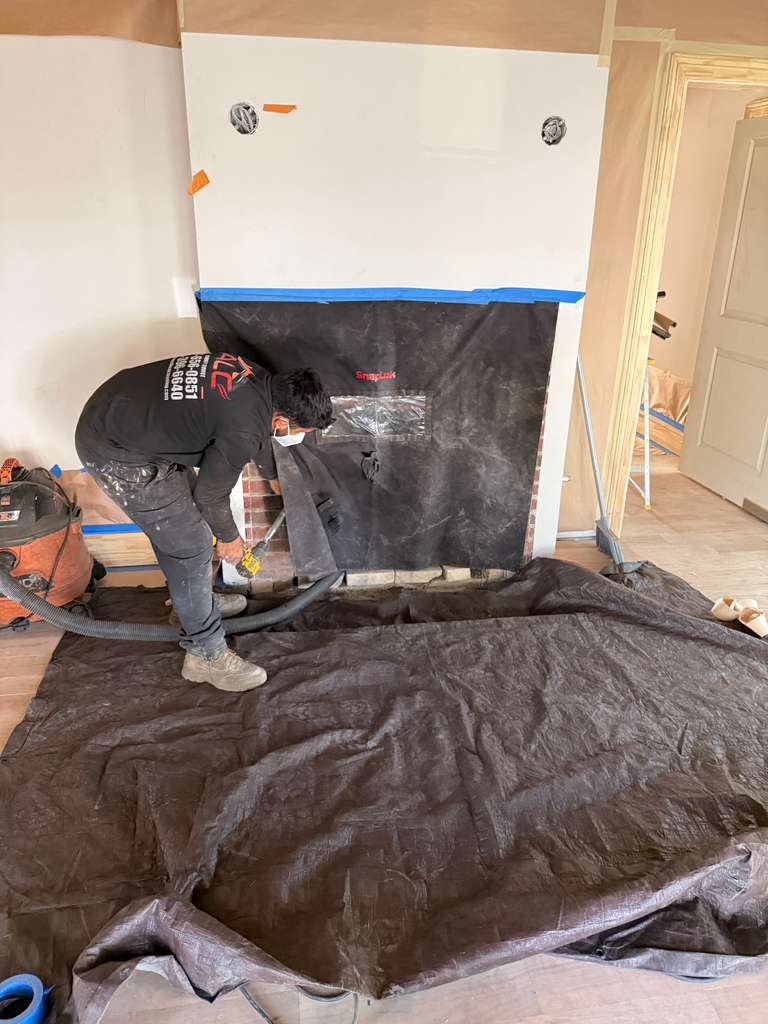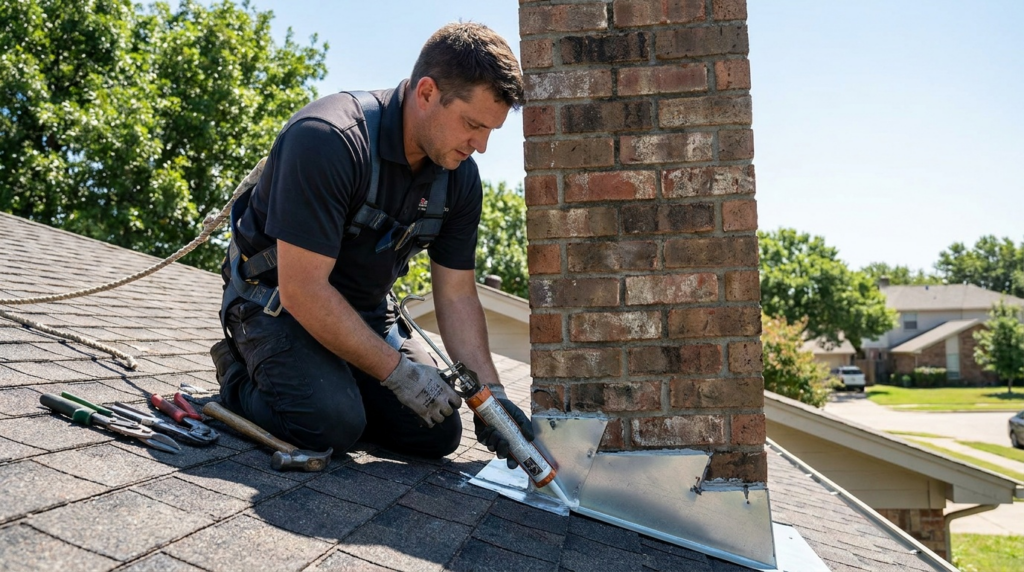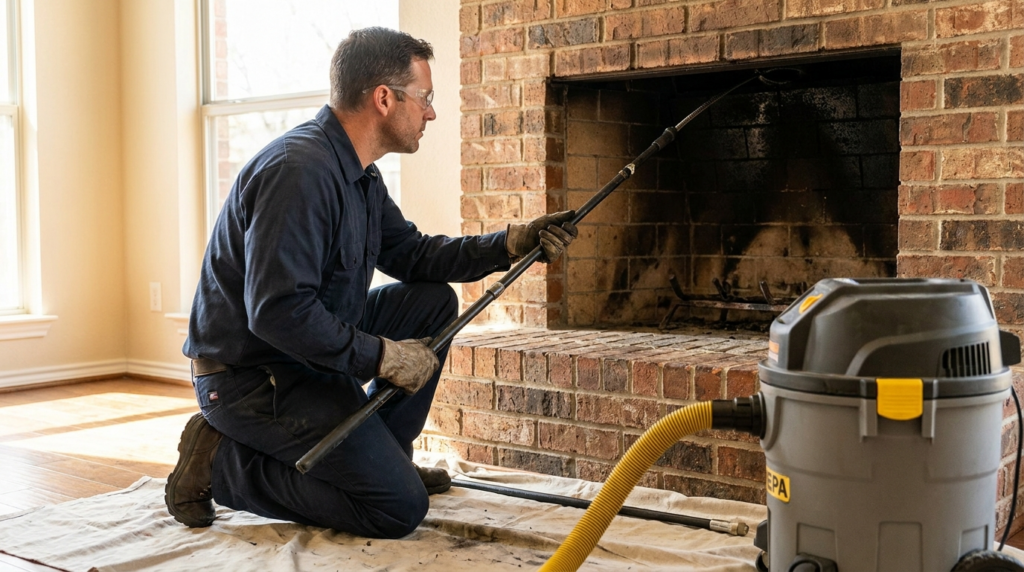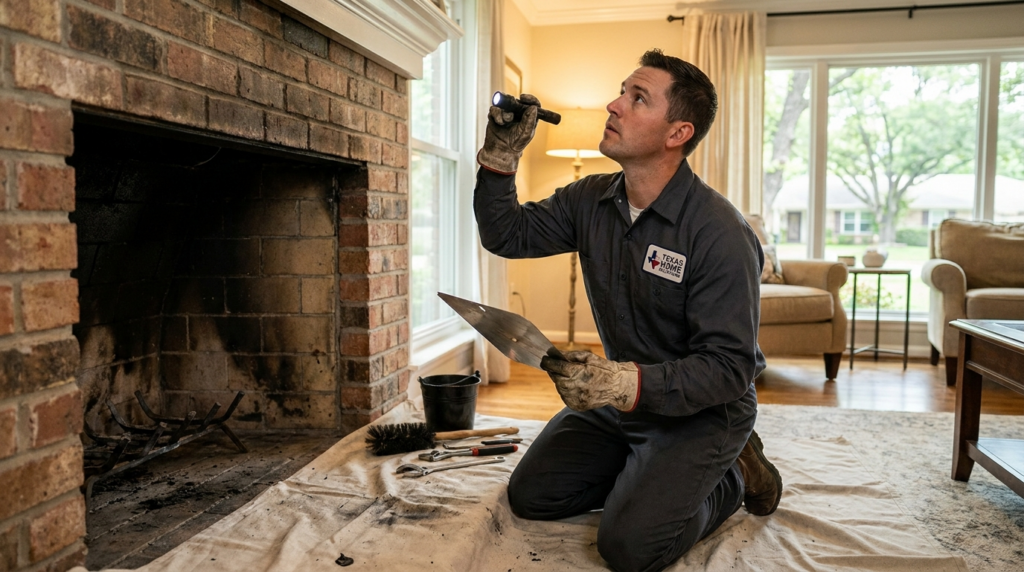
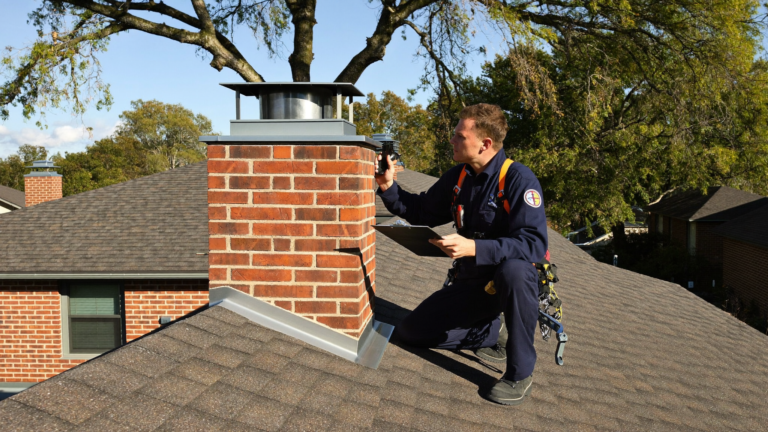
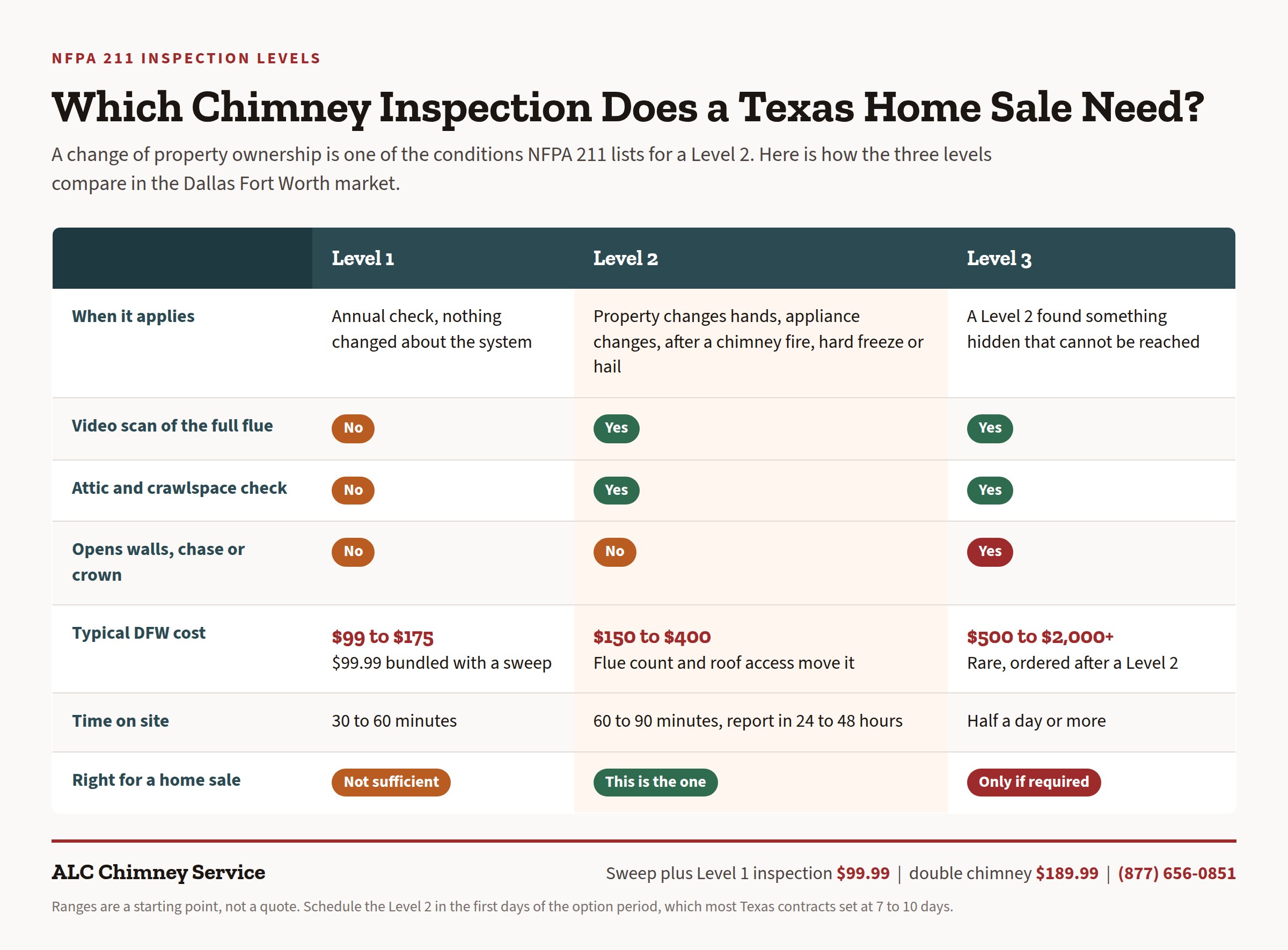
A Level 2 chimney inspection is the inspection standard for a home sale in Texas, and in the Dallas Fort Worth market it typically runs $150 to $400 depending on how many flues the house has and how far the technician has to travel. It is the level NFPA 211 calls for any time a property changes hands, any time the heating appliance changes, and after an event like a chimney fire, a hard freeze or a hail storm. Unlike a Level 1 visual check, a Level 2 adds a video scan of the full flue from the firebox to the crown, plus a look at accessible attic and crawlspace areas where the chimney passes through the structure. ALC Chimney Service performs Level 2 inspections across DFW, and a standard sweep with a Level 1 inspection is $99.99 if the flue simply needs cleaning first.
What a chimney inspection costs in the Dallas Fort Worth area, and why the number moves:
- Level 1 inspection, $99 to $175. A visual check of readily accessible portions. Priced at the low end when it is bundled with a sweep, higher as a standalone visit.
- Chimney sweep plus Level 1 inspection, $99.99. ALC’s standard rate for a single flue. A second flue on the same roof is $189.99 total, because the crew is already set up and only the cleaning time doubles.
- Level 2 inspection for a real estate transfer, $150 to $400. The spread comes from flue count, roof pitch and height, and whether the camera scan needs a cleaning first to see anything useful.
- Level 3 inspection, $500 to $2,000 and up. Rare, and only ordered when a Level 2 finds something hidden that cannot be evaluated without opening a wall, a chase or the crown.
- Add-on cleaning before the scan, $99 to $250. Heavy glazed creosote hides cracks from the camera, so the flue sometimes has to be cleaned before the inspection means anything.
- Written report with photos and video stills, usually included. Ask before booking. A report that a buyer’s agent and a lender will accept is the whole point of paying for a Level 2.
- Repairs found at inspection, $150 to $9,000. A missing cap is a few hundred dollars. A cracked clay liner that has to be replaced before the house can close is the top of that range.
The parts of the system a Level 2 report will name, in plain language:
- Flue. The vertical passage inside the chimney that carries smoke and combustion gases out of the house.
- Liner. The clay tile, stainless steel or cast-in-place surface inside the flue that keeps heat and gases away from the surrounding masonry and framing.
- Chimney crown. The sloped concrete or mortar slab on top of a masonry chimney that sheds water away from the brick below.
- Chase cover. The metal lid on top of a framed chase, which is what most post-1990 prefabricated fireplaces in DFW have instead of a masonry crown.
- Flashing. The layered metal that seals the joint where the chimney passes through the roof plane.
- Firebox. The chamber where the fire actually burns, built from firebrick and refractory mortar in a masonry system or from steel and refractory panels in a prefab.
- Creosote. The tar-like residue wood smoke leaves on the flue walls, which is combustible and is the reason annual cleaning exists.
Treat every figure above as a starting point rather than a quote. Chimney pricing in North Texas depends on things nobody can see from the driveway, including flue count, the condition of the liner and how hard the roof is to work on safely. A CSIA-certified technician should look at the system before anyone commits to a number. One honest warning about the coupon pricing that floods DFW inboxes every September: a $49 or $59 sweep is almost never a real sweep. It is a foot in the door, and the visit tends to end with an urgent five-figure recommendation and a same-day discount that expires when the truck pulls away. Real inspection pricing is boring, and a good report is often the one that tells you nothing is wrong.
Key Takeaways
- NFPA 211 calls for a Level 2 inspection any time a property changes ownership, so a Texas home sale with a fireplace is the textbook case for one.
- A Level 2 in the DFW market runs $150 to $400, and a standard sweep with a Level 1 inspection is $99.99 for a single flue or $189.99 for a double chimney.
- The defining difference is the camera. A Level 2 includes a video scan of the entire flue interior, which is the only way to document cracked tiles or a gap at a joint.
- A general home inspector’s report is not a chimney inspection. Most stop at the firebox and the roofline, and their own reports usually say so in the limitations section.
- Schedule the inspection in the first two days of the option period, which in most Texas contracts runs 7 to 10 days, so there is time to get repair bids before the deadline.
- Common transaction-stopping findings are a cracked or missing crown, failed flashing, a deteriorated clay liner and a prefab firebox with damaged refractory panels, and repairs run from $150 for a cap to $9,000 for a rebuild above the roofline.
What is a Level 2 chimney inspection, and why does a home sale trigger one?
NFPA 211 is the national standard that defines chimney inspections, and it sorts them into three levels. Level 1 is the annual check on a system that has not changed and is not suspected of a problem. Level 2 is the deeper look, and the standard specifically lists a change of property ownership as one of the conditions that requires it. Level 3 involves removing part of the structure to reach something a Level 2 could not evaluate. If you want the full breakdown of what separates them, we wrote a detailed guide to chimney inspection levels 1, 2 and 3.
The logic behind the ownership trigger is straightforward. The seller knows how the fireplace has been used and the buyer does not. A chimney can look perfect from the curb and from the hearth while carrying a cracked liner six feet up, a gap that lets flue gases into a bedroom wall, or a smoke chamber that was parged with the wrong material decades ago. None of that is visible without a camera, and none of it announces itself until somebody lights a fire in December.
Texas does not have a statewide law forcing a Level 2 before closing, and that catches people off guard. What actually drives it in practice is the contract, the lender and the general home inspector. TREC-licensed inspectors are required to report deficiencies they can see, and when they find soot staining, a rusted damper or a firebox they cannot fully evaluate, the standard move is to recommend further evaluation by a qualified chimney professional. That recommendation lands in the buyer’s report, the buyer’s agent sends it to the seller, and a Level 2 is what closes the open item.
Who usually pays for the inspection?
It depends on who ordered it. When a buyer’s inspector flags the chimney, the buyer normally pays for the Level 2 as part of their own due diligence. When a seller wants to get ahead of the issue, they pay for it before listing and hand the report to interested buyers, which is often the cheaper path. Either way, the inspection itself is a few hundred dollars and the repairs it uncovers are the real money, so the negotiation is almost never about the inspection fee.
Does the inspection have to happen before closing?
It should happen during the option period, not after. Once the option expires, the buyer has lost the clean exit and most of the leverage to ask for repairs or a credit. If a lender or an insurance carrier is the one asking, the report generally has to be in hand before funding.
What does a Level 2 chimney inspection actually include?
The technician works the system from bottom to top and inside to outside: the firebox and damper, the smoke chamber above it, the full flue interior on camera, the accessible exterior masonry, the crown or chase cover, the cap and the flashing at the roof. It also covers the accessible portions of the attic, crawlspace or basement where the chimney passes through, because that is where clearance-to-combustible problems hide. A framing member sitting tight against a masonry chimney is a real finding, and it is invisible from both the living room and the roof.
Plan on 60 to 90 minutes on site for a single flue, longer if the house has two fireplaces or a furnace flue sharing the same stack, which is common in Richardson, Garland and the older Plano subdivisions. The written report usually arrives within 24 to 48 hours with photographs and stills pulled from the video scan. For a real estate file, insist on the photos. A one-line verbal “it looks fine” is worth nothing when an agent forwards it to the other side.
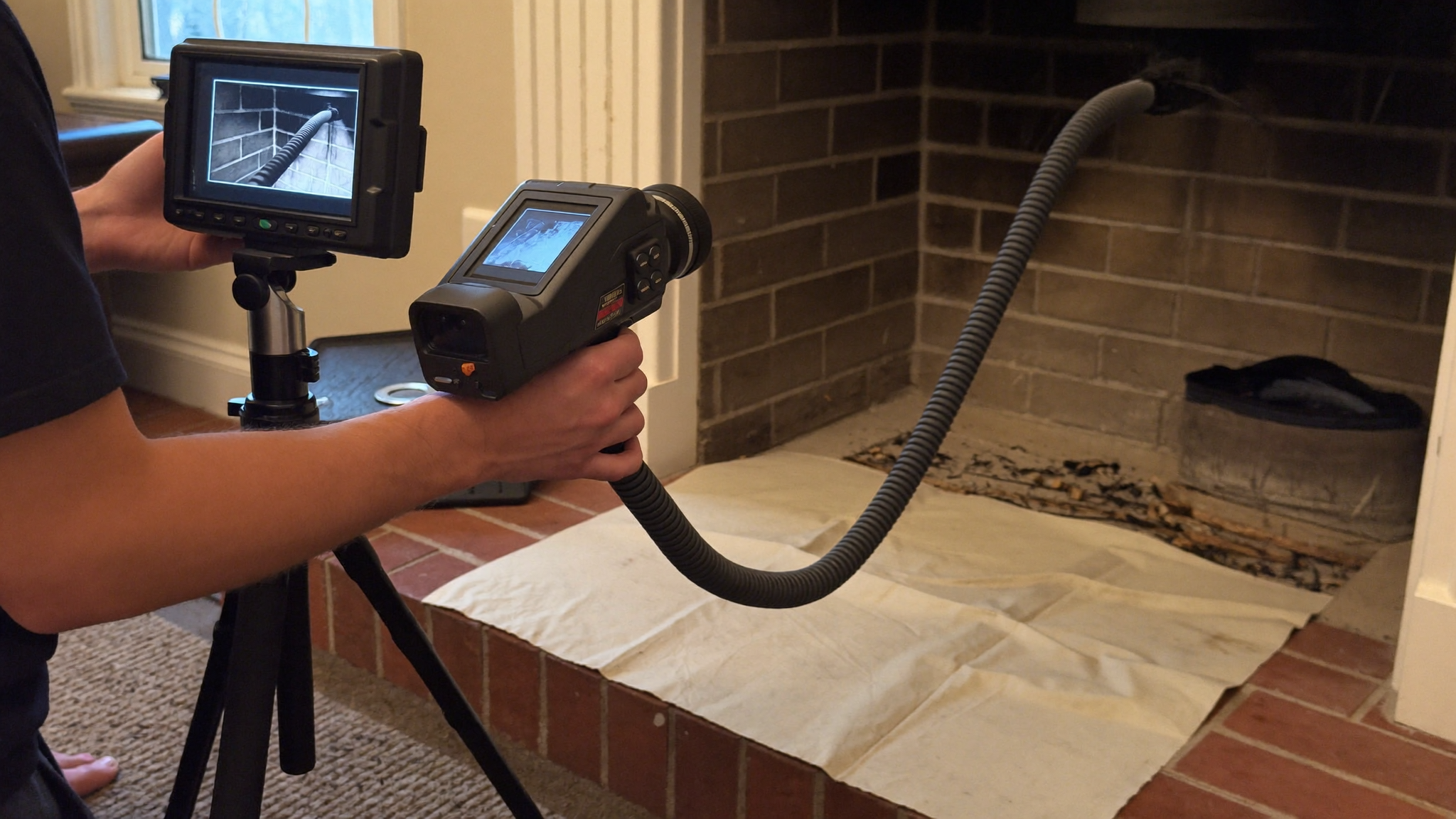
What does the camera scan show that a visual check cannot?
Hairline cracks in clay flue tiles, open mortar joints between tiles, gaps where a liner has shifted, missing sections in a smoke chamber parge coat, and the true depth of creosote glazing. Clay tiles crack from thermal shock, and North Texas gives them plenty of it when a 78-degree afternoon drops to 28 overnight and somebody runs a fire for six hours in between. A cracked liner is the single most common finding that turns into a real repair bill, and it is the reason we always look at the liner options and what each one costs before recommending anything.
Is a sweep included with the inspection?
Not automatically, and the distinction matters. A flue with heavy buildup has to be cleaned before a camera scan tells you anything, because creosote coats over the exact cracks you are looking for. If the technician arrives and finds a quarter inch of glazed deposits, expect the cleaning to be quoted separately or bundled. Our chimney sweep service and the inspection are often booked together for that reason.
How is a chimney inspection different from the general home inspection?
A general home inspector is a generalist by design, working through the roof, the foundation, the HVAC, the plumbing and the electrical in a few hours. On the chimney, the standard practice is a visual check of the firebox, the damper operation, the visible exterior masonry and whatever can be seen from the ground or a ladder. Most home inspection reports include an explicit limitation stating that the flue interior was not evaluated and that a Level 2 inspection by a chimney professional is recommended.
That is not a knock on home inspectors. They are doing exactly what their standards of practice require. It simply means the chimney portion of that report is a screening, and a screening that flags something needs a specialist to resolve it. The Chimney Safety Institute of America certifies technicians specifically for this work, and a CSIA credential is the thing to ask for when a report says “qualified professional.”
Will the inspection kill my deal?
Usually not. Across DFW, most Level 2 inspections on homes that are 15 to 30 years old come back with maintenance items rather than deal breakers: a missing cap, a crown with shrinkage cracks, flashing that needs resealing. Those run a few hundred to a couple thousand dollars and get handled with a credit or a repair before closing. The expensive findings show up in a minority of houses, and catching one before closing beats finding it in January.
What does a Level 2 inspection commonly find on a North Texas home?
The DFW housing stock creates predictable patterns. Homes built from the late 1970s through the early 1990s in Irving, Richardson, Garland and Mesquite tend to have full masonry chimneys with clay tile liners that are now 35 to 50 years old, and clay has a service life. Homes built after about 1995 in Frisco, Little Elm, Prosper and the Collin County corridor are overwhelmingly factory-built prefab systems inside a framed chase, where the failure points are the chase cover, the refractory panels and the manufacturer’s clearance requirements.
Weather does the rest. North Texas runs a punishing freeze-thaw cycle in January and February, hail season from March into June, and enough wind-driven rain to find any gap in flashing. Water is behind most of the masonry damage we document, which is why a crown crack that looks cosmetic in September is a spalled brick face by spring.
| What the inspection finds | What it leads to if ignored | Typical DFW repair cost |
|---|---|---|
| Cracked or missing chimney crown | Water runs into the brick and the flue, freeze-thaw spalls the masonry, liner deteriorates | $300 to $900 for a repair, $900 to $2,500 for a rebuilt crown |
| Failed or improperly layered flashing | Ceiling stains, rotted roof decking and framing around the chimney | $350 to $1,200 |
| Missing or damaged chimney cap | Rain, debris and animals in the flue, rusted damper, blocked draft | $150 to $600 installed |
| Cracked clay tile liner | Flue gases and heat reach framing, a fire and carbon monoxide hazard, system is unsafe to use | $2,500 to $5,500 for a stainless steel reline |
| Deteriorated mortar joints in the stack | Loose brick, leaning above the roofline, water entry through open joints | $800 to $2,500 for tuckpointing |
| Cracked prefab refractory panels | Steel firebox shell exposed to direct flame, manufacturer listing voided | $400 to $1,200 for panel replacement |
| Heavy glazed creosote, stage three | Chimney fire risk, flue obstruction, camera cannot document liner condition | $250 to $800 for specialized removal |
What is the most expensive thing a Level 2 can turn up?
A chimney that has to be rebuilt from the roofline up, which runs $3,500 to $9,000 in this market depending on height, brick match and access. That happens when years of water intrusion have destroyed the mortar and the brick faces above the roof plane, usually on a chimney that never had a proper crown or cap. It is also the finding most likely to be missed entirely by a ground-level look, because the damage is fifteen feet above anybody’s eye line.
How do you handle chimney repairs during a real estate transaction?
Get the report, get two written bids, and put numbers on the table rather than adjectives. “The chimney needs work” is an argument. “The liner scan shows cracked tiles at eight and eleven feet, here are two bids at $3,100 and $3,600 for a stainless reline” is a negotiation that resolves in a day.
Sellers generally have three options: complete the repair before closing, offer a credit at closing and let the buyer handle it, or adjust the price. Buyers who plan to use the fireplace usually prefer the repair to be done by a certified contractor before they take the keys, because a credit that turns out to be short is their problem in November. For anything structural, our chimney repair team in Dallas provides a free repair inspection and a written scope, which is the document that actually moves a transaction forward.
Does a cracked liner have to be fixed before closing?
No law requires it in Texas, but it frequently becomes a practical requirement. An insurance carrier writing a new policy can ask about it, a lender on certain loan products can require the appliance be safe and functional, and a buyer who has the report in hand has every reason to insist. Plan for it rather than hoping it passes quietly.
When should you schedule the inspection in a Texas transaction?
Day one or day two of the option period. Most Texas residential contracts carry a 7 to 10 day option, and that window has to absorb the scheduling, the inspection itself, the 24 to 48 hour report turnaround and then the time to collect repair bids. Booking on day six leaves no room, and in October and November, when DFW chimney companies are at their busiest, it can mean waiting past the deadline for an appointment.
There is also a seasonal argument for sellers. From mid-September through December the whole metroplex remembers it has a fireplace at the same time, and lead times stretch. A spring or summer inspection gets scheduled in days rather than weeks, which gives you months to shop repairs instead of accepting the first available crew. The city pages under our locations directory list the specific areas we cover.
How long is a Level 2 report good for?
There is no expiration stamped on it, but treat anything older than about a year with suspicion in a transaction, and anything predating a hard freeze or a hail event with more suspicion than that. February freezes have opened crown cracks that were not there in November. A report from two winters ago is useful history, not a current condition.
Why Choose ALC Chimney Service for a Home Sale Inspection?
ALC Chimney Service is a family owned company working across Dallas Fort Worth, with CSIA-certified technicians, full licensing and insurance, and more than 15 years of combined experience in the field. Our crews have completed over 10,000 jobs across the metroplex, and the listing carries a 5.0 rating from 172 and more Google reviews.
For a transaction, the practical points are these. A standard sweep with a Level 1 inspection is $99.99 for a single flue, or $189.99 for a double chimney. Repair inspections are free, so if a report flags something, getting a written scope and a real number costs nothing. There are no trip fees anywhere in our service area, which matters when the house is in Waxahachie and the buyer’s agent is in Frisco. And the report you get is one you can forward: photographs, video stills from the flue scan, and findings written so a buyer, an agent and a lender can all read them.
We also do not sell repairs we would not do on our own house. If the crown has shrinkage cracks that need sealing rather than a $2,000 rebuild, that is what the report says. If the system needs a new cap to keep water out, our chimney cap installation and repair service handles it the same week in most cases.
Frequently Asked Questions
Is a chimney inspection required by law when selling a house in Texas?
No Texas statute requires one before closing. NFPA 211, the national standard the industry works to, does call for a Level 2 inspection when a property changes ownership, and that standard is what home inspectors, insurers and chimney professionals reference. In practice the requirement usually arrives through the contract, the lender or a recommendation in the buyer’s general inspection report rather than through state law.
How much does a Level 2 chimney inspection cost in Dallas Fort Worth?
Expect $150 to $400 for a Level 2 with a video flue scan and a written report. The price moves with flue count, the height and pitch of the roof, and whether the flue needs cleaning first so the camera can see the liner surface. A sweep with a Level 1 inspection is $99.99 for one flue and $189.99 for a double chimney.
How long does the inspection take?
Usually 60 to 90 minutes on site for a single-flue system, longer when a house has two fireplaces or a furnace sharing the stack. The written report with photos and video stills typically follows within 24 to 48 hours, so build that into your option period timeline.
Can my general home inspector do the chimney inspection?
A TREC-licensed home inspector will evaluate what their standards of practice cover, which is generally the firebox, the damper and the visible exterior. They do not run a camera up the flue, and their reports normally state that limitation directly. When the report recommends evaluation by a qualified professional, that means a CSIA-certified chimney technician performing a Level 2.
What happens if the inspection finds a cracked flue liner?
The system should not be used until it is repaired, because a cracked liner lets heat and combustion gases reach framing and living space. The usual fix is a stainless steel reline, running roughly $2,500 to $5,500 in this market depending on flue height and diameter. In a transaction, the finding typically becomes either a seller repair, a closing credit or a price adjustment.
Should a seller inspect before listing?
It is often the cheaper move. A pre-listing Level 2 lets the seller shop repairs on their own schedule rather than under a deadline, and a clean report handed to buyers removes an objection before it is raised. Fixing something at a normal price also beats negotiating against a buyer’s worst-case estimate during the option period.
Does the chimney need to be swept before the inspection?
Only if there is enough buildup to hide the liner from the camera. A flue with light soot scans fine. A flue with a quarter inch of glazed creosote does not, and the scan is not worth running until it is cleaned. Our technician will tell you on arrival which situation you have, and pricing for the cleaning is given before any work starts. Our guide to creosote buildup in Texas chimneys explains why the stages matter.
What if the house has a prefab fireplace instead of masonry?
The Level 2 still applies, but the checklist changes. Factory-built systems are evaluated against the manufacturer’s listing, so the inspection covers the chase cover, the refractory panels, the firebox shell, the specific vent pipe the unit was listed with, and the required clearances. Mixing components between manufacturers voids the listing, a common finding where somebody replaced a damaged part with whatever the home center carried.
Can I use the fireplace after a failed inspection?
Not until the failure is corrected. A report that documents a cracked liner, a damaged firebox or a blocked flue is describing an active fire and carbon monoxide hazard, and using the fireplace anyway also creates an insurance problem if something does happen. Cap it, leave it unused and schedule the repair. Standards from NFPA exist because these failures have a well-documented history.
If you have a Texas home under contract with a fireplace in it, get the Level 2 done in the first days of the option period rather than the last. ALC Chimney Service performs Level 2 inspections across Dallas Fort Worth with a written photo report, and our standard sweep with a Level 1 inspection is $99.99 for a single flue or $189.99 for a double chimney, with free repair inspections and no trip fees in our service area. Call (877) 656-0851 to get on the schedule, or contact us here and we will work around your closing date.
Find our chimney safety tips faster on Google