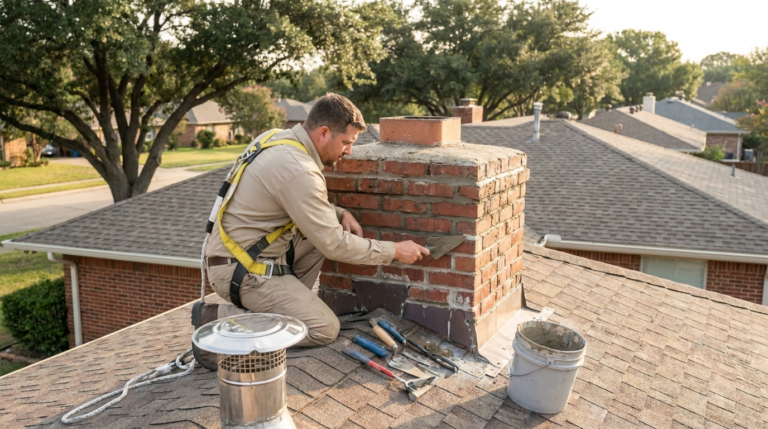
Chimney repair in Richardson, TX generally runs $200 to $3,500, depending on what failed. Minor mortar work and crown patching sit at the low end, while relining or partial rebuilds climb higher. Most Richardson homes were built between the 1960s and the early 2000s, so cracked mortar joints, spalling brick, and worn crowns are the repairs local technicians see most often.
That is the short version, and it is roughly what you would want if you were standing in the yard squinting at a stack of brick wondering how bad it is. The longer version is more useful though, because the price gap between a $300 fix and a $6,000 rebuild almost always comes down to how early somebody looked. I have spent enough seasons on Dallas County roofs to say that most of the expensive jobs started as something small that a homeowner reasonably decided to watch for another year.
What are the most common chimney repairs in Richardson, TX?
Richardson’s housing stock explains most of the pattern. Neighborhoods like Richardson Heights, Canyon Creek, Greenwood Hills, and Northrich went up largely in the 1950s through the early 1970s, which means a lot of original masonry is now fifty or sixty years old. Mortar does not last forever. Neither do crowns or flashing. So the repair list here skews toward wear rather than sudden failure.
Deteriorated mortar joints and tuckpointing
This is the one I quote most. Mortar is softer than brick by design, so it erodes first, which is actually the point since it protects the brick. Once the joints recede, water gets behind the face of the masonry and the damage accelerates. Tuckpointing means grinding out the failed mortar and packing in fresh, and on a Richardson chimney with a few bad courses it is a same-day job. Left for another five years, it turns into a rebuild conversation.
Cracked or crumbling chimney crown
The crown is the concrete slab at the top that sheds water off the masonry. When it cracks, water runs straight down inside the chimney wall instead of off it. A lot of homes from that era got a thin mortar crown rather than a proper poured one, and thin crowns crack early. Minor cracks take a repair mortar and an elastomeric sealer. A crown that has broken into pieces has to be rebuilt.
Flashing leaks where the chimney meets the roof
Flashing is the metal seal between the chimney and the roof deck. It fails from hail, from roof replacements done in a hurry, and from ordinary age. If you have a water stain on a ceiling near the fireplace, flashing is usually the first suspect. Worth saying plainly: not every chimney leak is a masonry problem, and I have seen homeowners pay for waterproofing when the actual issue was six feet of bad flashing.
Spalling brick
Spalling is when the face of a brick flakes off or pops away, leaving a pitted crater. It happens after water soaks into the brick and then freezes. North Texas does not get long winters, but it gets repeated freeze-thaw swings, and that cycling is harder on masonry than a steady cold. Once a brick spalls it cannot be patched. It gets replaced.
Flue liner damage
Inside the chimney, the flue liner is what keeps heat and combustion gases away from the surrounding structure. Older Richardson homes typically have clay tile liners, and clay cracks, particularly after a chimney fire or years of moisture. A damaged liner is a carbon monoxide and fire risk, and it is not something to defer. The fix is usually a stainless steel chimney relining, which is more expensive than any of the exterior repairs but also the one I would never tell somebody to postpone.
Missing or rusted chimney cap
Cheapest item on the list, and probably the one that prevents the most expensive problems. A cap keeps rain, leaves, and animals out of the flue. Richardson gets enough squirrels and enough hail that caps take a beating. If yours is rusted through or gone entirely, a chimney cap installation is a small job with an outsized payoff.
How much does chimney repair cost in Richardson, TX?
Direct answer: most Richardson homeowners pay $200 to $700 for minor repairs, $1,000 to $3,500 for major structural work, and $4,000 to $15,000 for a full rebuild or replacement. The wide spread is not vagueness, it just reflects how different these jobs are. Repointing a few joints and rebuilding a chimney above the roofline are not the same trade problem.
| Repair type | Typical Richardson cost | Notes |
|---|---|---|
| Chimney cap replacement | $300 to $900 | Stainless steel lasts longest |
| Crown repair, minor cracks | $200 to $700 | Repair mortar plus elastomeric sealer |
| Crown rebuild | $800 to $3,000 | When the slab has broken apart |
| Flashing repair or replacement | $300 to $1,800 | Cost depends on roof pitch and access |
| Tuckpointing, partial | $400 to $1,500 | Priced by square footage of joint work |
| Brick replacement, spalling | $500 to $2,500 | Matching old Richardson brick adds time |
| Stainless steel relining | $2,500 to $6,500 | Height and offsets drive the number |
| Firebox repair | $500 to $2,500 | Refractory panels or firebrick |
| Partial rebuild above roofline | $1,500 to $4,500 | Common on 1960s stacks |
| Full chimney rebuild | $5,000 to $15,000 | Structural failure or leaning stack |
Those are general Richardson ranges rather than a quote. Your actual price depends on height, roof access, how much of the masonry is involved, and whether the damage reached anything structural. ALC offers a free repair inspection, so getting a real number does not cost anything. There is also a $99.99 sweep plus inspection promotion and a $189.99 double chimney package if you want the cleaning handled at the same time.
What drives the price up
Access is the quiet cost multiplier. Richardson has plenty of single-story ranch homes where a technician can work comfortably off a ladder, and that keeps labor down. Two-story homes with steep pitches sometimes need scaffolding or a lift. Brick matching matters too. Sixty-year-old brick is not sitting on a shelf at a supply house, so sourcing something that blends takes effort, and a mismatched patch on a front-facing chimney is the kind of thing you notice every day afterward.
The other factor is how far the water traveled. A crown crack caught in year one is a crown repair. The same crack found in year six may have soaked the masonry, rusted the damper, damaged the liner, and stained the drywall inside. Same original problem, four times the invoice.
Why do chimneys in Richardson fail faster than homeowners expect?
People move here from colder places and assume mild winters mean easy conditions for masonry. It does not really work that way. A few local factors do real damage.
Freeze-thaw cycling is the first. North Texas swings across the freezing line repeatedly through winter rather than staying frozen. Water gets into a hairline crack, expands when it freezes, widens the crack, then thaws and goes deeper. A steady cold climate does this once or twice a season. We do it a dozen times or more.
Expansive clay soil is the second, and it is the one that surprises people. The Blackland Prairie clay under much of Dallas County swells when wet and shrinks when dry. Chimneys are heavy, often on their own footing, and that ground movement can tilt or pull a stack over decades. If your chimney has separated slightly from the exterior wall, or you can see a gap opening at the siding, soil movement is a likely part of the story.
Hail is the third. Richardson sits in a corridor that takes regular spring storms, and hail chews up caps, dents flashing, and chips mortar joints. Worth a look after any significant storm, particularly if your roof was inspected and the chimney was not.
Then there is age. The math is straightforward. A home built in 1968 in Greenwood Hills has masonry that has been through roughly sixty winters, sixty summers of Texas heat, and a lot of storms. Original mortar reaching the end of its service life is normal, not neglect.
Repair or rebuild: how do you decide?
This is the question homeowners actually want answered, and the honest response is that it depends on where the damage is rather than how bad it looks. Surface damage that has not reached structure is repair territory. Anything that compromises the load path or the flue leans toward rebuild.
| Condition | Usual approach | Reasoning |
|---|---|---|
| Eroded mortar joints, brick sound | Repair, tuckpointing | Structure intact, joints restorable |
| Cracked crown, no interior damage | Repair | Crown is a surface component |
| Leaking flashing | Repair | Roofing detail, not masonry |
| Scattered spalled brick | Repair, replace affected units | Localized damage |
| Widespread spalling above roofline | Partial rebuild | Too many failed units to patch |
| Visible lean or separation from house | Rebuild | Structural, often foundation-related |
| Cracked clay tile liner | Relining | Safety issue, repair is not viable |
| Repair estimate above rebuild cost | Rebuild | Better long-term value |
A rough rule I use out loud with customers: if repairs are running past about half the cost of a rebuild, and the chimney is already six decades old, put the money into the rebuild instead. You are otherwise buying a few years. That said, plenty of older Richardson chimneys have decades left in them and only need mortar and a crown. Nobody should assume the worst before somebody actually looks.
Warning signs your Richardson chimney needs repair
Some of these are obvious. Others are easy to attribute to something else, which is how they get missed.
- White chalky staining on the exterior brick, called efflorescence, which means water is moving through the masonry.
- Mortar joints that are recessed, crumbling, or dropping sand when you rub them.
- Brick faces that are flaking, pitted, or popping off.
- Water stains on the ceiling or wall near the fireplace, or a damp smell after rain.
- Rust on the damper or firebox, which almost always means water is getting in above.
- Pieces of tile or masonry debris in the firebox, a possible sign of liner failure.
- A visible tilt in the stack, or a gap opening where the chimney meets the siding.
- Smoke drawing poorly or backing into the room, which can point to a blockage or a damaged flue.
- Cracked or crumbling panels inside the firebox itself, which points toward firebox repair rather than exterior work.
If you see debris falling or hear scratching, that may be an animal rather than damage, though the two often travel together since a broken cap invites both. Either way it gets handled before any repair work starts.
Homeowner checklist before you call for a repair estimate
None of this is required. It does make the visit faster and the estimate more accurate.
- Note when you first saw the problem and whether it has changed since.
- Photograph any stains, cracks, or debris, especially interior water marks.
- Check whether the issue tracks with rain, which points toward crown, cap, or flashing.
- Find out roughly when the house was built and whether the roof has been replaced.
- Locate any past inspection or repair paperwork from previous owners.
- Skip fires for at least 24 hours before the appointment so the system is cool.
- Clear access to the fireplace and to the side of the house for ladder placement.
- Ask whether the estimate includes a camera scan of the flue, since exterior damage often has an interior counterpart.
What happens during a chimney repair inspection?
A repair assessment is not the same as a routine cleaning visit, though the two overlap. The technician is looking for cause rather than just condition. Typical sequence:
- Interior review of the firebox, damper, and smoke chamber, checking for rust, cracks, and moisture evidence.
- Exterior masonry walk, examining joints, brick faces, the crown, and the cap.
- Roofline and flashing check where the chimney passes through the roof.
- Flue scan, often with a camera, to confirm whether the liner is intact.
- Written findings with photos, so you can see what the technician saw rather than take it on faith.
Ask for the photos. A reputable company will offer them without being asked, and if somebody quotes several thousand dollars of masonry work without showing you anything, that is a reasonable moment to get a second opinion. Most repair assessments take under an hour on a single-chimney home.
How this connects to your annual service
Repairs and routine maintenance are separate jobs, but they find each other constantly. A standard chimney sweep includes a Level 1 visual inspection, and that is where most repair needs first turn up. If the technician sees something questionable, the next step is a Level 2 chimney inspection with a camera to confirm what is happening inside the flue. NFPA Standard 211 calls for annual inspection of chimneys for soundness, deposits, and proper clearances, which is the whole reason the yearly visit exists. It is cheaper to find a cracked crown in July than to discover it in January when it is leaking into the living room.
When is the best time to schedule chimney repair in Richardson?
Late spring through early fall, without much hesitation. Masonry work needs reasonable weather. Mortar and sealants cure poorly in the cold, and a wet or freezing week can push a job back repeatedly. Summer also means shorter waits, since the whole metroplex calls at once around the first cold front in late October.
There is a practical angle too. Repairs found during a summer inspection have months of runway before you need the fireplace. The same finding in December means choosing between an emergency booking and a winter without a working fireplace. I have watched that decision go badly enough times to keep bringing it up.
Why hire a CSIA-certified chimney company?
Chimney work sits in an awkward spot between roofing, masonry, and heating, and plenty of general contractors will take the job without much specific training. CSIA certification means the technician has been trained and tested against chimney and venting standards, which matters most on the parts you cannot see. A mason can rebuild a beautiful stack and still leave a liner problem in place.
ALC Chimney Service is family-owned, licensed and insured, with more than 15 years of combined experience and over 10,000 jobs completed across Dallas and the DFW metroplex. The company holds a 5.0 rating across 172 Google reviews. You can read more about the team if you want the background before calling.
Richardson is inside the regular service area, along with neighboring Plano and Garland. The Richardson service page has local details, and the full service area list covers the rest of the metroplex. For the repair work itself, the main chimney repair page goes deeper into methods and materials. Ready to find out what you are actually dealing with? Contact ALC Chimney Service or call (877) 656-0851 for a free repair inspection.
Frequently Asked Questions
How much does chimney repair cost in Richardson, TX?
Minor repairs such as crown patching or partial tuckpointing typically run $200 to $700. Major structural work lands between $1,000 and $3,500. Full rebuilds range from $5,000 to $15,000 depending on height and access. A free inspection is the only way to get an accurate number for your chimney.
How do I know if my chimney needs repair or a full rebuild?
Damage limited to mortar joints, the crown, flashing, or a handful of spalled bricks is usually repairable. A visible lean, separation from the house, or widespread spalling across the stack points toward a rebuild. If repair estimates approach half the cost of rebuilding an older chimney, rebuilding often makes more financial sense.
Why do so many Richardson homes have chimney problems?
Most of Richardson was built between the 1960s and the early 2000s, so a large share of chimneys have original masonry that is fifty or sixty years old. Add repeated freeze-thaw cycling, expansive clay soil that shifts foundations, and regular spring hail, and mortar and crown deterioration become common rather than unusual.
Is a cracked chimney crown urgent?
It should be handled within the season. The crown sheds water off the top of the chimney, and once it cracks, water runs into the masonry instead of off it. That leads to spalling brick, a rusted damper, and eventually liner damage. Crown repair is inexpensive compared with what it prevents.
Can I repair chimney mortar myself?
Small ground-level patching is possible for a confident DIYer, but tuckpointing requires grinding out old joints to the proper depth and matching mortar type. Modern high-strength mortar on older soft brick causes the brick to fail instead of the joint. Roof-level work also carries real fall risk. For anything above the roofline, hire it out.
Does homeowners insurance cover chimney repair?
Insurance usually covers sudden damage from a covered event such as hail, a storm, or a chimney fire. It generally does not cover gradual deterioration like eroded mortar or a worn crown, since those are considered maintenance. After a significant hailstorm it is worth having the chimney documented separately from the roof claim. Policies vary, so check with your carrier.
How long does chimney repair take?
Cap replacement and minor crown work often finish in a few hours. Tuckpointing and brick replacement typically take one to two days. A partial rebuild runs two to four days, and a full rebuild can take a week or more. Weather delays masonry work, which is another reason to schedule during warm months.
Should I repair the chimney before selling my Richardson home?
Usually yes. Chimney defects turn up during buyer inspections, and an open finding tends to cost more in negotiation than the repair would have. A Level 2 inspection before listing gives you documentation and time to address anything found on your own schedule rather than under a contract deadline.
About the Author
Jonathan is a CSIA-certified chimney specialist at ALC Chimney Service with more than 15 years of hands-on experience sweeping, inspecting, and repairing fireplaces and chimneys across Dallas and the DFW metroplex. He has worked on thousands of residential chimney systems and writes to help North Texas homeowners keep their fireplaces safe, efficient, and up to NFPA and CSIA standards. Have a question about your chimney? Call ALC Chimney Service at (877) 656-0851 for a free inspection.