Skip to content
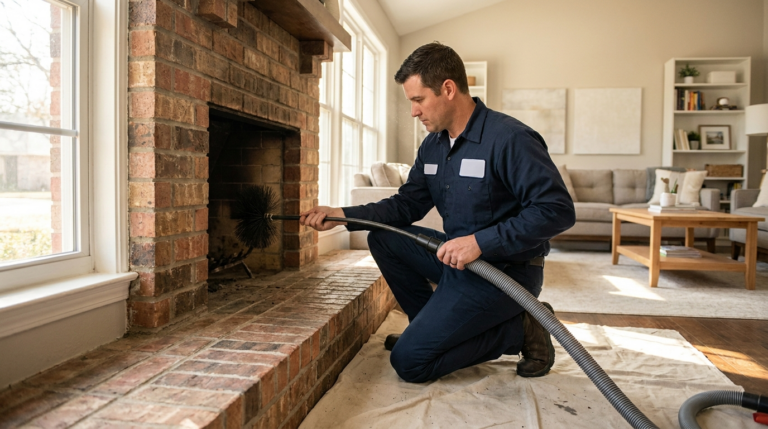
Most Plano, TX homes need a chimney cleaning at least once a year, and sooner if you burn wood often or notice smoke, odor, or heavy soot. A CSIA-certified sweep removes creosote and blockages from the flue, then checks the damper, firebox, liner, and cap so your fireplace runs safely through the North Texas winter. Annual service is the baseline the NFPA recommends.
That is the quick answer. The longer answer is where it gets useful, because “once a year” is a starting point, not a rule that fits every house. How much you burn, what you burn, the age of your chimney, even the way your Plano neighborhood was built all shift the timing. I have cleaned enough flues around Collin County to know that two homes on the same street can be on very different schedules. Let me walk through how to figure out yours.
How often should you clean a chimney in Plano, TX?
The short version, once more, with a little more detail: clean it at least once a year, and clean it whenever creosote reaches about 1/8 inch on the flue walls, whichever comes first. That 1/8 inch figure is the Chimney Safety Institute of America’s threshold, and it is a good one to keep in your head. Once buildup hits that thickness, it is enough to feed a flue fire.
The annual part comes from NFPA Standard 211, which says chimneys, fireplaces, and vents should be inspected at least once a year for soundness, deposits, and correct clearances. Notice the word inspected. Not every annual visit ends in a full sweep. Sometimes the tech looks, finds the flue clean enough, and you are done. But you do not know that until someone checks, and the checking is the point.
Here is a rough guide to frequency based on how you actually use the fireplace. Treat it as a range, not gospel.
| How you use the fireplace | Suggested cleaning frequency |
|---|---|
| Occasional wood fires (a few times a season) | Once a year |
| Regular wood burning (weekly through winter) | Once a year, sometimes twice |
| Heavy daily wood use for heat | Every 1 to 2 cords of wood, or twice a season |
| Gas fireplace or gas logs | Annual service and vent check, no brushing |
| Rarely or never used | Annual inspection, clean only if buildup found |
One thing people miss: an unused chimney still needs a yearly look. Animals nest in it, moisture works into the masonry, and a rusted cap lets both in. I have opened up flues that had not seen a fire in three years and found a squirrel’s nest packed solid at the smoke shelf. So “we barely use it” is not a reason to skip the annual visit. It is just a reason you probably will not need a full brushing.
Why Plano homes need regular chimney cleaning
Plano is a mix. You have the older neighborhoods, West Plano, parts of the area around Willow Bend, homes that have had working fireplaces for decades and masonry that has been through a lot of freeze-thaw cycles. Then you have the newer builds farther north with prefab, factory-built fireplaces. Both need cleaning. They just wear differently.
The older masonry chimneys tend to show their age at the crown and the mortar joints. North Texas is rough on brick in a way that surprises people who assume our winters are mild. It is not the cold itself, it is the swing. A warm week, then a hard freeze, then warm again. Water gets into a hairline crack, freezes, expands, and slowly pries the masonry apart. By the time you notice a stain on the ceiling near the fireplace, the water has usually been getting in for a while. A yearly cleaning is the natural moment to catch that before it becomes a chimney repair bill.
The newer prefab systems have their own quirk. Homeowners assume a factory-built fireplace is somehow low-maintenance or self-cleaning. It is not. It still produces creosote when you burn wood, and the metal firebox and flue have manufacturer clearances and parts that wear. If anything, a prefab needs the annual check just as much, because a damaged panel or a failing liner in a metal system is a real safety issue, not a cosmetic one.
And then there is creosote, which is the reason all of this matters in the first place. Every wood fire sends smoke up a relatively cool flue, and as that smoke cools it leaves behind a tarry, flammable residue. The NFPA links thousands of home chimney fires each year to creosote that was not cleaned out in time. That is the whole case for regular cleaning in one sentence. It is not about a tidy fireplace. It is about not having a fire inside your chimney wall.
What causes creosote to build up faster
Not every fireplace coats its flue at the same rate, and a few habits speed it up a lot. If you recognize yourself in this list, you are probably on the more-than-once-a-year end of the range.
- Burning wet or unseasoned wood, which holds moisture and smolders instead of burning hot.
- Burning high-resin softwoods like pine, which leave more tar behind than seasoned hardwoods.
- Damping the fire down low for long, slow burns that never really heat the flue.
- A chimney that runs cold, often an exterior masonry chimney, so smoke cools and deposits quickly.
- Poor draft or airflow, sometimes from an undersized or partly blocked flue.
Seasoned hardwood burned hot and clean is your friend here. It will not eliminate creosote, nothing does, but it slows the buildup considerably. I usually tell folks that how they burn matters more than they think, and it is the one variable they actually control.
Signs your Plano chimney is overdue for cleaning
The calendar is one signal. The fireplace itself is another, and it is often the louder one. A few things I would treat as your chimney asking for attention:
- A strong smoky or campfire smell drifting from the fireplace, which tends to get worse in humid weather.
- Smoke pushing back into the room instead of drawing up the flue, a classic sign of a blockage or heavy buildup.
- Black, oily soot flaking down into the firebox or coating the damper.
- Fires that are slow to start or burn sluggishly, pointing to poor draft.
- A dark, shiny, tar-like glaze visible on the flue walls when you shine a flashlight up.
- Debris, twigs, or animal sounds coming from the chimney, which usually means a missing or damaged cap.
That glaze on the last-but-one point deserves a note. Glazed creosote, the hard shiny kind, is the most dangerous stage and the hardest to remove. If you see even a thin film of it, do not keep burning. It should be dealt with right away. If you are hearing scratching or seeing twigs rather than soot, that is an animal removal situation first, before any cleaning can happen.
What a professional chimney cleaning includes
People picture a brush and not much else. The brush is real. But a proper cleaning is a system job that goes well beyond the part you can see. Here is what a thorough Plano chimney cleaning should cover.
The technician lays down drop cloths and seals off the fireplace opening so soot does not drift into the room, then runs a HEPA vacuum the whole time to control dust. The cleaning itself works through the flue and liner, the smoke chamber and smoke shelf, the firebox, and the damper. While up top, a good tech also eyes the chimney cap and crown, since those are where water and animals get in.
Most sweeps include a Level 1 visual inspection with the cleaning, a check of the readily accessible parts of the system. If the tech spots something off, a crack, a soft mortar joint, a liner that looks wrong, they may suggest a Level 2 chimney inspection with a camera to see inside the flue. I think of the sweep and the inspection as one visit with two jobs: one cleans, the other confirms it is safe to light. If a liner has actually failed, that is where a relining conversation starts.
The three stages of creosote
Creosote is not one substance, and the stage you are dealing with is a big reason two seemingly identical cleanings cost different amounts.
| Stage | What it looks like | Removal difficulty |
|---|---|---|
| Stage 1 | Light, flaky, sooty dust | Easy, standard brushing |
| Stage 2 | Crunchy, tar-like flakes | Moderate, needs more tools |
| Stage 3 | Hard, shiny glazed tar | Difficult, special treatment |
Stage 1 is what you want, and it is what regular yearly cleaning keeps you at. Let the interval stretch, burn a lot of wet wood, and you drift toward Stage 2 and eventually Stage 3, which is both the most flammable and the most expensive to remove. That progression is the practical argument for not skipping years. The buildup does not just sit there, it hardens.
How much does chimney cleaning cost in Plano, TX?
A standard single-chimney cleaning in Plano generally runs about $120 to $350, with most homeowners landing in the $150 to $300 range once a basic inspection is bundled in. Gas fireplace service sits lower, roughly $100 to $200, since there is no creosote to brush out. Wood systems with heavy buildup or a Level 2 camera inspection push toward the top of the range, and occasionally past it.
A few things move the number. Chimney height and roof access matter, a tall or steep two-story flue sometimes needs a lift. Multiple chimneys in one house add up. And condition counts, a flue neglected for several years takes longer than one cleaned last spring.
| Service | Typical Plano price range | Notes |
|---|---|---|
| Standard sweep + Level 1 inspection | $120 to $350 | Most common single-chimney job |
| Gas fireplace service | $100 to $200 | No creosote, vent and connection check |
| Level 2 camera inspection | $200 to $500 | Home sales, after a chimney fire, or when damage is suspected |
| Second chimney, same visit | Add $90 to $150 | Discounted when done together |
| Heavy creosote / glazed removal | $250 to $600+ | Stage 3 glaze is stubborn and time-consuming |
ALC Chimney Service runs a promo worth knowing about: a sweep plus inspection for $99.99, a double chimney package for $189.99, and free repair inspections. The prices above are general Plano-area ranges rather than a formal quote, since the real figure depends on your specific system. A quick call gets you an exact number.
When is the best time to book chimney cleaning in Plano?
Summer and early fall, which feels backwards when it is 100 degrees outside, but there is a good reason. Everyone in Plano calls at the same time, roughly late October into December, the first genuinely cold week. Schedules fill fast, and you end up waiting past the point you wanted your first fire.
Book in June, July, or August and you get your pick of dates, shorter lead times, and a calmer visit. There is a repair angle too. If the summer inspection turns up a cracked crown or a failing liner, you have weeks to fix it, rather than discovering it during a January cold snap when you want to use the fireplace that night. I have watched homeowners wait two or three weeks in November for a slot that would have been next-day in July. The off-season is simply the easier time to get this handled.
Can you clean your own chimney in Plano?
You can buy a brush kit and knock some soot loose from below, and plenty of people do. The catch is that a DIY pass rarely reaches the smoke chamber and shelf, almost never catches early masonry cracks, and gives you no reliable read on creosote stage or liner condition. The cleaning is only half of what a professional visit is for. The other half is a trained set of eyes confirming the whole system is safe to use.
CSIA certification means the technician has been trained and tested on chimney and venting standards, well beyond basic brushing technique. ALC Chimney Service is family-owned, licensed and insured, with more than 15 years of combined experience and over 10,000 jobs across Dallas and DFW. The company holds a 5.0 rating across 172 Google reviews, which for a trade business is worth something. You can read more about the team if you want the background.
A quick homeowner checklist before your appointment
You do not need to do much to prep, but a little goes a long way toward a smooth, quick visit.
- Do not burn any fires for at least 24 hours beforehand so the system is fully cool.
- Clear a path to the fireplace and move fragile items a few feet back.
- Note anything you have observed: odd smells, smoke problems, animal sounds, water stains.
- Know roughly how often you use the fireplace and whether it burns wood or gas.
- Make sure the technician can safely reach the roof if an exterior look is needed.
- Keep pets in another room during the visit.
- Have any past inspection paperwork handy, useful if you are selling the home.
Plano sits in the heart of the metroplex, and ALC covers it along with the surrounding cities. If you are closer to a neighboring town, the same crew handles chimney services in McKinney, Allen, and Richardson, and you can check the full service area map to confirm your neighborhood. For the core cleaning process, the Dallas chimney sweep service page has more detail, and a general fireplace cleaning often clears up lingering odors. Ready to get on the summer schedule? Contact ALC Chimney Service or call (877) 656-0851 to book your Plano cleaning and inspection.
Frequently Asked Questions
How often should I have my chimney cleaned in Plano, TX?
At least once a year, following NFPA Standard 211, and sooner if creosote reaches about 1/8 inch, which is the CSIA’s cleaning threshold. Homes that burn wood frequently or use unseasoned wood often need cleaning twice a season. Gas fireplaces still need an annual service and vent check even though they do not produce creosote.
How much does chimney cleaning cost in Plano?
A standard single-chimney cleaning in Plano typically costs $120 to $350, with most homeowners paying $150 to $300 when a basic inspection is included. Gas fireplace service runs lower, around $100 to $200. Heavy creosote or a Level 2 camera inspection raises the price.
Does a chimney that is rarely used still need cleaning?
It still needs an annual inspection. An unused chimney can collect animal nests, moisture damage, and debris even without creosote from fires. The inspection confirms it is safe, and a full cleaning is only needed if buildup or blockage is found.
How do I know if my chimney has too much creosote?
Warning signs include a strong smoky odor, smoke entering the room, black oily soot flaking into the firebox, sluggish fires, and a dark tar-like glaze on the flue walls. If you see glazed creosote in any amount, stop using the fireplace and have it cleaned right away, since glaze is highly flammable.
Is chimney cleaning the same as a chimney inspection?
No. A cleaning removes creosote, soot, and blockages. An inspection evaluates the condition and safety of the system. Most standard cleanings include a Level 1 visual inspection. A Level 2 inspection uses a camera and is recommended before a home sale, after a chimney fire, or when damage is suspected.
How long does a chimney cleaning take?
A straightforward single-chimney cleaning usually takes about 45 minutes to an hour and a half. Heavy creosote, a hard-to-access roof, or added repairs can extend that. Most Plano appointments wrap up within a couple of hours.
Do newer prefab fireplaces in Plano need cleaning too?
Yes. Factory-built prefab fireplaces still produce creosote when burning wood and have metal fireboxes, liners, and clearances that need checking. Newer construction does not mean maintenance-free, and a damaged panel or liner in a prefab system is a genuine safety concern.
What is the best time of year to book chimney cleaning in Plano?
Summer and early fall. Booking June through August means shorter waits, easier scheduling, and time to handle any repairs the inspection turns up before you need the fireplace. The rush from October onward fills schedules quickly.
About the Author
Jonathan is a CSIA-certified chimney specialist at ALC Chimney Service with more than 15 years of hands-on experience sweeping, inspecting, and repairing fireplaces and chimneys across Dallas and the DFW metroplex. He has worked on thousands of residential chimney systems and writes to help North Texas homeowners keep their fireplaces safe, efficient, and up to NFPA and CSIA standards. Have a question about your chimney? Call ALC Chimney Service at (877) 656-0851 for a free inspection.
Find our chimney safety tips faster on Google