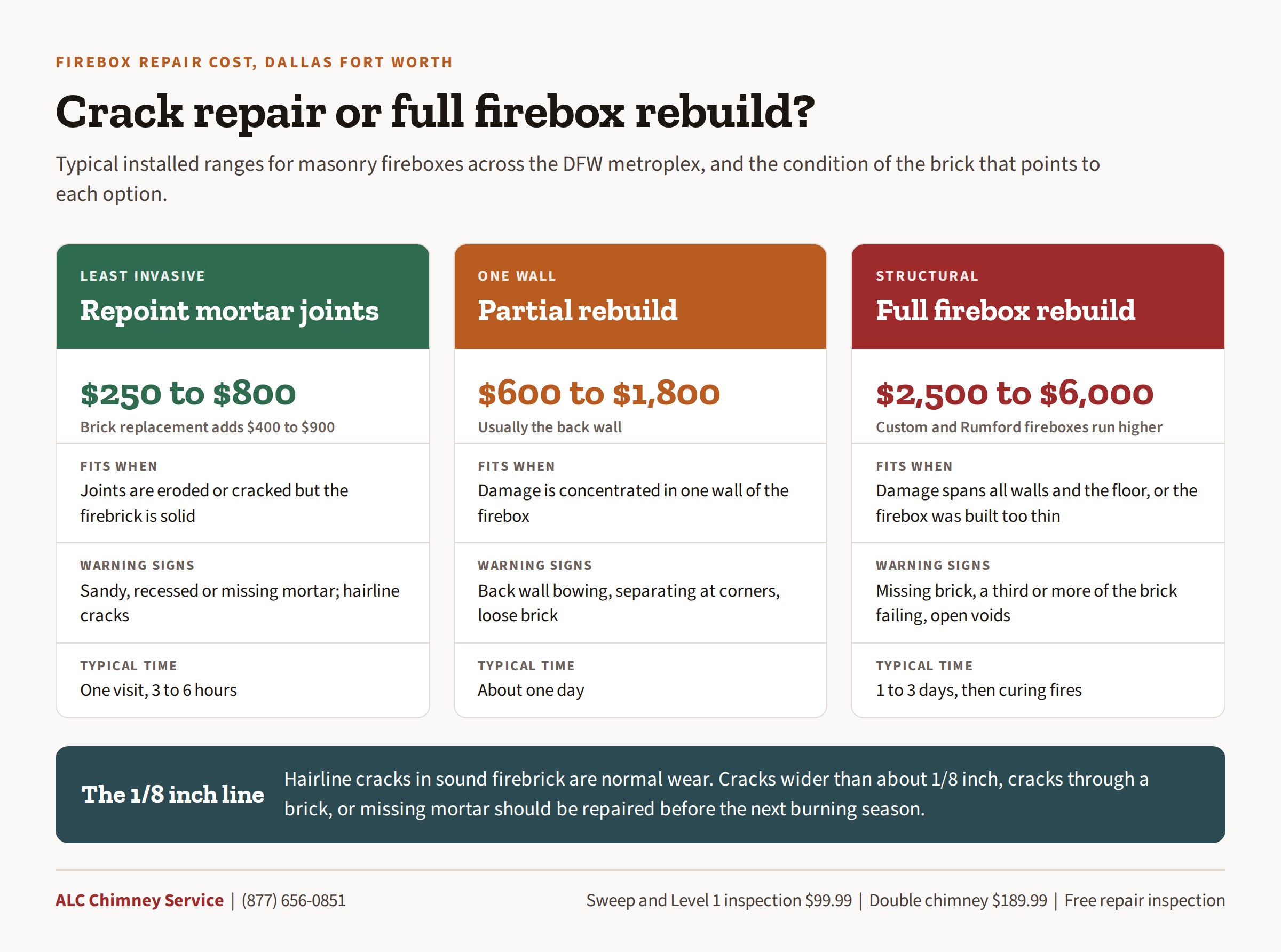
Firebox repair cost in Dallas Fort Worth usually lands between $250 and $800 when the damage is limited to cracked or eroded mortar joints, $600 to $1,800 when a section of firebrick has to come out and be relaid, and $2,500 to $6,000 for a full masonry firebox rebuild. What decides which one you need is the condition of the brick itself: hairline cracks in sound firebrick are normal wear, while bricks that are loose, spalled, missing, or pushed out of line mean the firebox is no longer holding heat away from the framing behind it. Price also moves with firebox size, whether the damper and smoke chamber have to be opened up for access, and whether the original work used the wrong mortar. ALC Chimney Service looks at the firebox as part of every $99.99 sweep and Level 1 inspection, and the repair inspection itself is free, so you know which side of the line you are on before anyone quotes a rebuild.
What firebox repair costs in the DFW metroplex, and why each number moves:
- Repointing firebox mortar joints, $250 to $800. Old mortar is raked out and replaced with medium-duty refractory mortar. The range tracks how many joints have failed and whether the back wall or only the sides are affected.
- Replacing a few damaged firebricks, $400 to $900. Individual bricks that are cracked through or crumbling are cut out and replaced. Cost rises when matching an older brick size takes extra cutting.
- Partial rebuild of one wall, $600 to $1,800. Usually the back wall, which takes the most direct heat. Price depends on wall height and whether the smoke shelf above it needs work at the same time.
- Full masonry firebox rebuild, $2,500 to $6,000. All three walls and often the inner hearth floor are torn out and relaid. Oversized fireboxes, Rumford designs, and custom stonework push toward the top of the range and occasionally past it.
- Inner hearth floor replacement, $400 to $1,500. The firebrick floor that the grate sits on. It cracks from dropped logs and from heat soaking into a thin base.
- Refractory panel replacement in a prefab fireplace, $300 to $900. Factory-built units use manufacturer panels instead of firebrick, and the part has to match the model number.
- Level 2 camera inspection before a rebuild, $150 to $400. Recommended when the firebox damage may be a symptom of a bigger problem such as settlement, water entry, or a failed smoke chamber.
The parts of a fireplace this guide refers to:
- Firebox: The open chamber where the fire burns, built from firebrick and refractory mortar in a masonry fireplace.
- Firebrick: A dense, heat-resistant brick made to survive direct flame. It is paler and harder than the face brick on your fireplace surround.
- Refractory mortar: A heat-rated mortar used to set firebrick. Ordinary Portland cement mortar breaks down when it sits next to a fire.
- Inner hearth: The firebrick floor inside the firebox, separate from the hearth extension that sits out in the room.
- Smoke chamber: The funnel-shaped space above the damper that narrows the fireplace opening down to the flue.
- Damper: The metal plate that opens and closes the throat of the chimney at the top of the firebox.
- Refractory panel: A molded ceramic panel that lines the firebox of a prefab, factory-built fireplace in place of firebrick.
Treat these ranges as a starting point, not a quote. Firebox damage is often the visible end of something happening elsewhere in the chimney, so a CSIA-certified technician should look at the whole system before you commit to a price. Be careful with coupon offers that advertise a very cheap sweep and then turn up a “crumbling firebox” that needs an immediate rebuild. Ask to see the damage with a flashlight, ask for photos, and ask whether repointing would solve it. An honest company will tell you when it would.
Key Takeaways
- Repointing failed firebox mortar joints costs $250 to $800 in DFW, while a full masonry firebox rebuild runs $2,500 to $6,000.
- Most technicians treat a crack wider than about 1/8 inch, or any crack that runs through a brick rather than along a joint, as a repair item rather than normal wear.
- Building code sets masonry firebox walls at 8 inches of solid masonry when a 2-inch firebrick lining is used, and a rebuild has to restore that.
- Firebrick must be set in heat-rated refractory mortar, and patches made with ordinary mortar are one of the most common reasons a firebox fails early.
- NFPA 211 and the CSIA both call for an annual chimney inspection, and the firebox is part of every Level 1 inspection.
- The best time to schedule firebox work in North Texas is late summer, before the first cold front in October fills repair calendars.
What is the difference between firebox crack repair and a full firebox rebuild?
Crack repair works on the joints and on individual bricks while leaving the rest of the firebox in place. A technician grinds or rakes out the damaged mortar, cleans the joint, and packs it with refractory mortar. If a few bricks are cracked all the way through or have started to flake, those are cut out and replaced one at a time. The firebox keeps its original shape, dimensions, and most of its original brick.
A full rebuild starts with demolition. Every firebrick on the back wall, the two side walls, and usually the inner hearth comes out down to the supporting masonry, and the firebox is relaid from scratch. That is the only option when the problem is structural, for example when the back wall has bowed forward, when bricks are falling out, or when the firebox was built too thin to begin with.
Most of the fireboxes we see in North Texas land in the first group. Houses from the 1970s and 1980s in Richardson, Garland, Lake Highlands, and central Arlington often have fireboxes that have been used for forty winters and show plenty of cracking, but the brick is still solid and a day of repointing brings them back.
What counts as a hairline crack?
A hairline crack is one you can see but cannot fit a credit card into. Firebrick expands and contracts every time you build a fire, so fine surface cracks show up in almost every firebox that gets real use. They are not an emergency on their own, but they are worth noting at each inspection so you can tell whether they are growing.
How do I know if my firebox cracks are serious?
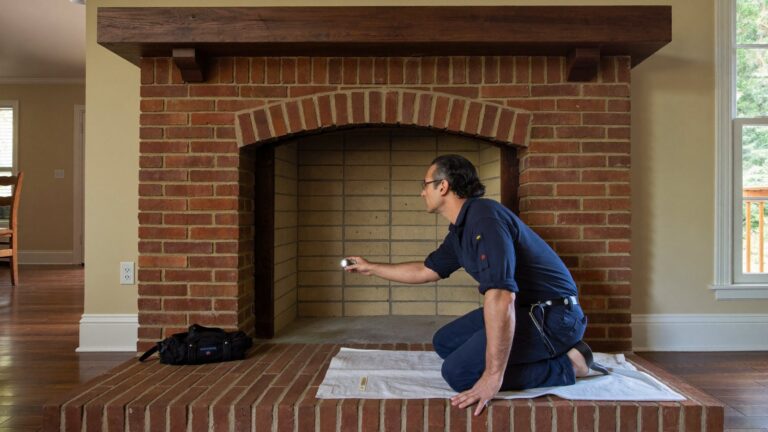
Start with a flashlight and a cold fireplace. Look at the joints first. Healthy refractory mortar is thin, hard, and flush with the face of the brick. Failed mortar is recessed, sandy, or missing altogether, and you can often scratch it out with a key. Missing mortar matters more than a cracked brick, because an open joint is a direct path for heat into the masonry behind the firebox.
Next, look at the bricks themselves. A crack that follows a mortar joint is less of a concern than one that runs across the face of a brick. Spalling, where the face of the brick flakes off in layers, usually points to moisture getting into the firebox, often from a failed chimney crown or a missing cap. Loose bricks that shift when you press on them are a clear sign the firebox needs more than a patch.
Finally, step back and look at the shape. The back wall should be straight and plumb. If it leans toward the room, has a visible belly, or has pulled away from the side walls at the corners, the problem is structural and the conversation shifts toward a partial or full rebuild.
Is a 1/8 inch crack the dividing line?
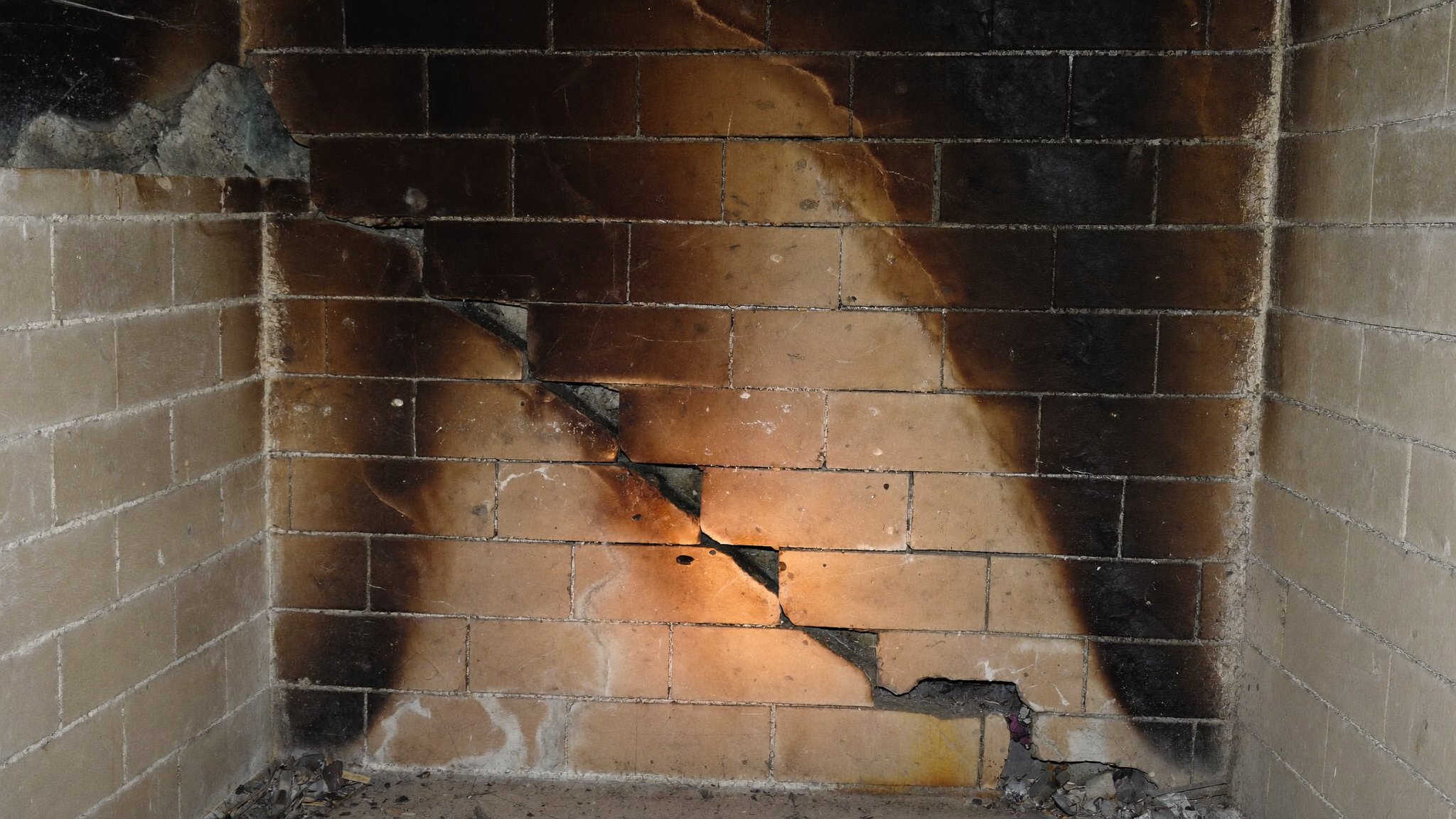
It is the rule of thumb most chimney technicians use. A crack narrower than about 1/8 inch in otherwise sound firebrick is usually monitored or sealed with refractory mortar. Anything wider, anything you can see light or daylight through, and any crack that has opened up since the last inspection is treated as a repair item.
What does it mean when the back wall leans or bulges?
A bowed back wall means the bond between the firebrick and the masonry behind it has broken down, usually from years of heat cycling with failed mortar joints. It cannot be pushed back into place. The affected wall has to be taken down and relaid, and a technician will check the smoke shelf above it at the same time.
When does firebox damage call for a Level 2 inspection?
When the damage looks like it came from somewhere else. Cracks that line up with cracks in the exterior chimney, spalling from water, or a firebox that has shifted relative to the hearth all point to causes that a Level 1 visual check cannot fully see. A Level 2 inspection adds a camera run through the flue and a closer look at the smoke chamber and crown. You can read more about what each chimney inspection level includes before you decide.
How much does firebox repair cost in Dallas Fort Worth?
For most homeowners the realistic range is $250 to $1,800. That covers repointing, replacing damaged bricks, and rebuilding the back wall on its own, which together account for the large majority of firebox work in DFW. A full rebuild at $2,500 to $6,000 is the exception, and it usually follows years of deferred maintenance or a firebox that was built poorly in the first place.
The biggest cost drivers are the amount of brick that has to come out, the size and shape of the firebox, and access. A standard 36-inch firebox in a 1980s tract home in Mesquite or Carrollton is quick to work on. A 48-inch firebox with a raised hearth in an older Preston Hollow or Fairmount home, or a Rumford fireplace with its tall, shallow shape, takes more material and more labor.
Hidden damage adds to the bill. If the smoke chamber has open joints or the damper frame has rusted loose, it makes sense to fix those while the firebox is open. Our firebox repair service in Dallas quotes these as separate line items so you can see exactly what each part costs.
Why is a full rebuild priced so widely?
Because no two fireboxes are the same size and few are in the same condition under the brick. The low end reflects a standard firebox with a sound base. The high end reflects oversized or custom fireboxes, stone surrounds that have to be protected during demolition, and supporting masonry that needs repair before new firebrick can go in.
Does a prefab firebox cost less to fix?
Usually, yes. Most homes built across Collin and Denton County after 1990 have factory-built fireplaces with refractory panels rather than firebrick. Replacing a cracked panel set runs $300 to $900. The catch is that panels must match the unit’s model, and if the whole prefab unit is past its service life, replacing panels only delays a bigger decision.
When is a full firebox rebuild actually required?
A rebuild is required when the firebox can no longer do its job of containing heat and flame. In practice that means bricks that are loose or missing across a large part of a wall, a back wall that has bowed or separated, damage spread across all three walls and the floor, or a firebox that was never built to code. A good technician will not recommend a rebuild because a firebox looks old or dark. Soot staining and scattered hairline cracks are normal.
There is also a practical threshold. When roughly a third or more of the brick in a firebox needs replacing, the labor to cut out and patch individual bricks starts to approach the cost of a rebuild, and the result is not as sound. At that point relaying the firebox is usually the better use of money.
What does code say about firebox wall thickness?
The International Residential Code, which DFW cities adopt with local amendments, calls for the back and side walls of a masonry firebox to be at least 8 inches of solid masonry when a firebrick lining at least 2 inches thick is used, or 10 inches when there is no lining. The firebox must also be at least 20 inches deep, or 12 inches for a Rumford design. A rebuild has to meet these dimensions, and NFPA 211 sets the same expectation for safe construction.
What causes firebox damage in North Texas homes?
Heat cycling is the baseline cause everywhere. Every fire heats the face of the firebrick to several hundred degrees while the masonry behind it stays much cooler, and over hundreds of fires that difference opens up the joints. North Texas adds a few problems of its own on top of that.
The first is water. A cracked chimney crown or a missing cap lets rain run down the flue and soak into the firebox, and spring storm season from March to June delivers plenty of it. Wet firebrick that is then heated by a fire in December spalls and cracks much faster than dry brick. The second is the ground itself. Much of Dallas, Collin, and Tarrant County sits on expansive clay soil that swells when wet and shrinks during August droughts, and that movement shows up as cracks in slabs, brick veneer, and fireboxes.
Use matters too. Many DFW fireplaces sit idle for years and then get pushed hard during a cold snap, as a lot of them were during the February 2021 winter storm. Very large, hot fires built in a firebox that has not been inspected in years are one of the fastest ways to turn small cracks into loose brick.
Does foundation movement crack fireboxes?
It can. When a slab settles or heaves, the heavy masonry chimney often moves differently from the house around it. Cracks that run diagonally through both the firebox and the fireplace surround, or a gap opening between the hearth and the firebox, are signs worth showing to a foundation specialist as well as a chimney technician.
Can the wrong mortar make things worse?
Yes, and it is one of the most common problems we find. Firebrick has to be set in refractory mortar that meets ASTM C199. A previous owner or handyman who patched joints with regular masonry mortar or a hardware store caulk has created a repair that will crumble within a season or two, and the failed material has to be removed before a proper repair can go in.
What happens if I keep using a cracked firebox?
Small cracks in solid firebrick will not cause a fire tomorrow, but open joints and missing brick let heat travel into places it was never meant to reach. Behind and beside a masonry firebox there is often wood framing, sometimes closer than current code would allow in older homes. Repeated exposure to heat can slowly char that wood over years, lowering the temperature at which it will ignite. That process, called pyrolysis, is why fire investigators take firebox gaps seriously, and the risk climbs further when creosote buildup in the flue has been left to accumulate at the same time.
The table below shows how common firebox findings tend to progress when they are left alone, and what they usually cost to fix at each stage.
| Firebox finding | What it leads to if ignored | Typical DFW repair cost |
|---|---|---|
| Hairline cracks in sound firebrick | Gradual widening over several seasons of use | Monitor, or $150 to $300 to seal |
| Eroded or missing mortar joints | Heat reaching masonry and framing behind the firebox | $250 to $800 to repoint |
| Individual bricks cracked through or spalling | Loose brick and open voids in the wall | $400 to $900 to replace |
| Back wall bowed or separating at corners | Wall collapse into the fire area | $600 to $1,800 for one wall |
| Cracked or sunken inner hearth | Embers and heat under the hearth floor | $400 to $1,500 |
| Widespread damage on all walls and floor | Firebox no longer safe to use | $2,500 to $6,000 full rebuild |
Can heat from a cracked firebox reach the framing?
Yes. Open joints and missing brick create a path for hot gases and radiant heat into the masonry and any wood near it. This is one of the reasons NFPA 211 calls for damaged fireboxes to be repaired before the fireplace goes back into use, and why a technician may tag a fireplace as unsafe until the work is done.
How long does firebox repair take, and when can I use the fireplace again?
Repointing and brick replacement are usually finished in a single visit of three to six hours. A partial rebuild of the back wall is typically a one-day job. A full rebuild takes one to three days depending on size and whether the damper or smoke chamber is being repaired at the same time. Crews lay drop cloths from the front door to the hearth and seal the fireplace opening, so dust stays out of the room.
After the mortar is laid it needs time to set before it sees heat. Most refractory mortar manufacturers call for a waiting period followed by a few small curing fires that bring the firebox up to temperature gradually. Skipping that step and building a large fire right away can crack fresh joints before they have fully hardened.
What are curing fires?
Curing fires are small, short fires built over several days after a repair. They drive remaining moisture out of the new mortar slowly so it does not steam and crack. Your technician will give you the schedule for the product used, and following it matters more than most homeowners expect.
When is the best time of year to schedule firebox work?
Late summer and early fall. Demand for all fireplace repair in Dallas climbs sharply after the first real cold front, usually in late October or November. Booking in August or September gives the mortar time to cure fully before you need the fireplace, and it is easier to get a date that suits you.
Why Choose ALC Chimney Service for Firebox Repair in Dallas Fort Worth?
ALC Chimney Service is a family-owned company with CSIA-certified technicians, fully licensed and insured, and more than 15 years of combined experience working on North Texas fireplaces. We have completed more than 10,000 jobs across the DFW metroplex and hold a 5.0 rating from more than 172 Google reviews. When we look at a firebox, we photograph what we find and explain whether it needs repointing, a partial rebuild, or a full rebuild, and why.
Our standard chimney sweep with a Level 1 inspection is $99.99, and $189.99 for a double chimney. Repair inspections are free, and there are no trip fees anywhere in our service area. If the firebox damage points to a bigger issue, we can schedule a chimney inspection in Dallas or handle related chimney repair at the crown, liner, or exterior masonry in the same visit. We work to NFPA 211 and the standards taught by the Chimney Safety Institute of America.
Frequently Asked Questions
How much does it cost to repair cracks in a firebox?
Repointing cracked or eroded mortar joints in a masonry firebox usually costs $250 to $800 in Dallas Fort Worth. If individual bricks are cracked through and need replacing, expect $400 to $900. The final price depends on how many joints have failed, the firebox size, and whether earlier repairs used the wrong mortar that has to be removed first.
How much does a full firebox rebuild cost?
A full masonry firebox rebuild typically costs $2,500 to $6,000 in the DFW area. The low end covers a standard firebox with sound supporting masonry. Oversized fireboxes, Rumford designs, stone surrounds that need protection during demolition, and damper or smoke chamber work done at the same time push the price higher.
Are cracks in firebrick normal?
Fine hairline cracks are normal in any firebox that gets regular use, because firebrick expands and contracts with every fire. They should be noted at each annual inspection. Cracks wider than about 1/8 inch, cracks that run through a brick, and missing mortar are not normal wear and should be repaired before the next burning season.
Can I repair my firebox myself?
Small hairline cracks can be sealed with a refractory mortar product by a careful homeowner, but anything beyond that is best left to a professional. Using the wrong mortar, packing joints poorly, or missing a structural problem behind the brick can make the damage worse and create a hidden fire risk. A free repair inspection will tell you what you are dealing with.
Does homeowners insurance cover firebox repair?
Insurance generally does not cover firebox wear from age and normal use. It may cover damage from a sudden event such as a chimney fire, lightning strike, or a storm that damaged the chimney and let water in. Photos and a written inspection report from a CSIA-certified technician make any claim much easier to support.
How long does firebox mortar last?
Properly installed refractory mortar in a firebox that gets moderate use commonly lasts 15 to 25 years or more. Heavy burning, water entry from a failed crown or missing cap, and patches made with the wrong mortar all shorten that. An annual inspection catches failing joints early, when repointing is still a small job.
Is it safe to use a fireplace with a cracked firebox?
It depends on the damage. Hairline cracks in solid brick are generally safe for normal fires until a repair is scheduled. Missing mortar, loose bricks, or a back wall that is bowing mean heat can reach the masonry and framing behind the firebox, and the fireplace should not be used until it is repaired.
Do prefab fireplaces have a firebox that can be repaired?
Yes. Factory-built fireplaces use molded refractory panels instead of firebrick, and cracked panels can be replaced for about $300 to $900 when the correct part for the unit’s model is available. If the unit is discontinued or its metal firebox is warped or rusted through, replacing the whole fireplace may be the safer choice.
If you have noticed cracks, crumbling mortar, or loose brick inside your fireplace, have it looked at before the burning season starts. ALC Chimney Service offers a free firebox repair inspection anywhere in Dallas Fort Worth, and our $99.99 sweep with a Level 1 inspection covers the firebox, damper, flue, and crown in one visit. Call (877) 656-0851 or book online through our contact page and we will get you on the schedule.
Find our chimney safety tips faster on Google