Skip to content
A standard chimney sweep in Grapevine runs $99.99 for a single flue at ALC Chimney Service, and that price includes the Level 1 inspection NFPA 211 asks for once a year. A home with two chimneys or two flues sharing one stack is $189.99. Independent companies across Tarrant County generally quote $150 to $350 for the same visit, and the spread comes down to what the technician finds once the damper is open. A chimney off Main Street that has been burning red oak since the 1950s can carry a quarter inch of glazed creosote, which takes a rotary head and a chemical treatment to break loose and adds $250 to $600. A prefab system in one of the newer subdivisions near Grapevine Lake usually sweeps in under an hour, but the money moves to the chase cover and the refractory panels instead. Flue count, system age, and seasons since the last cleaning are what move the number.
What chimney work typically costs in Grapevine and the surrounding Tarrant County suburbs:
- Sweep with a Level 1 inspection, $99.99 at ALC and $150 to $350 elsewhere. The range widens when a company bills the inspection report separately or adds a fuel surcharge for anything north of the airport.
- Second flue or second fireplace, $189.99 for the pair. Many Grapevine homes built after 1995 have a great room fireplace and a second one in the primary bedroom, and each flue is a separate job.
- Glazed creosote removal, $250 to $600 on top of the sweep. Third degree creosote has to be broken down chemically, because a poly brush polishes it rather than removing it.
- Level 2 inspection with camera scan, $250 to $500. Called for before a home sale, after a chimney fire, after a hard freeze that could crack flue tile, or when the fuel type changes.
- Chimney cap or chase cover replacement, $175 to $1,400. A stainless cap sits at the low end and a full chase cover on a two story roofline at the high end. Galvanized covers rust through after eight or nine North Texas summers, which is why so many get replaced.
- Crown repair and tuckpointing, $350 to $2,500. Resurfacing a cracked crown is a half day, while repointing a stack that has been shedding mortar since the 2021 freeze is a different job.
- Stainless steel liner installation, $2,500 to $5,500. Driven by flue height, offsets in the smoke chamber, and whether the clay tiles have to come out first.
The parts of your chimney a technician will name during the walkthrough:
- Flue. The vertical passage carrying smoke and combustion gases out of the house, built as clay tile, stainless steel, or the metal pipe inside a prefab system.
- Creosote. The tar-like residue wood smoke leaves as it cools on the flue wall. It burns hot enough to crack clay tile, which is why annual sweeping exists.
- Damper. The metal plate above the firebox that opens to let smoke out and closes to keep conditioned air in. Rusted and warped dampers are routine on older Grapevine masonry.
- Chimney crown. The sloped slab covering the top of a masonry chimney around the flue tiles. Cracks here let water into the brickwork, and water is what destroys masonry here.
- Chase cover. The flat metal lid on a prefab chimney chase, the boxed frame wrapped in siding or brick veneer that so many 1990s and 2000s homes have. It is the prefab equivalent of a crown.
- Flashing. The layered metal sealing the joint where the chimney passes through the roof deck. When a ceiling stain shows up near the fireplace wall, flashing is the first suspect.
- Firebox. The chamber where the fire burns, built as firebrick in a masonry system and as molded refractory panels in a prefab.
Treat every figure above as a starting point rather than a quote. Two houses on the same Grapevine street can need very different work depending on how much they burned last winter, so a CSIA-certified technician needs to open the damper, get a camera into the flue, and look at the crown before anyone puts a real number on the job. One thing worth saying plainly: a $49 sweep coupon is almost never a sweep. It is a way to get a technician in the door, and the real bill arrives after a list of urgent findings that somehow always totals a few thousand dollars.
Key Takeaways
- NFPA 211 calls for a chimney inspection every year regardless of how much you burn, and a sweep whenever creosote reaches roughly an eighth of an inch.
- A single flue sweep with a Level 1 inspection is $99.99 at ALC, and a second flue or second fireplace brings the visit to $189.99.
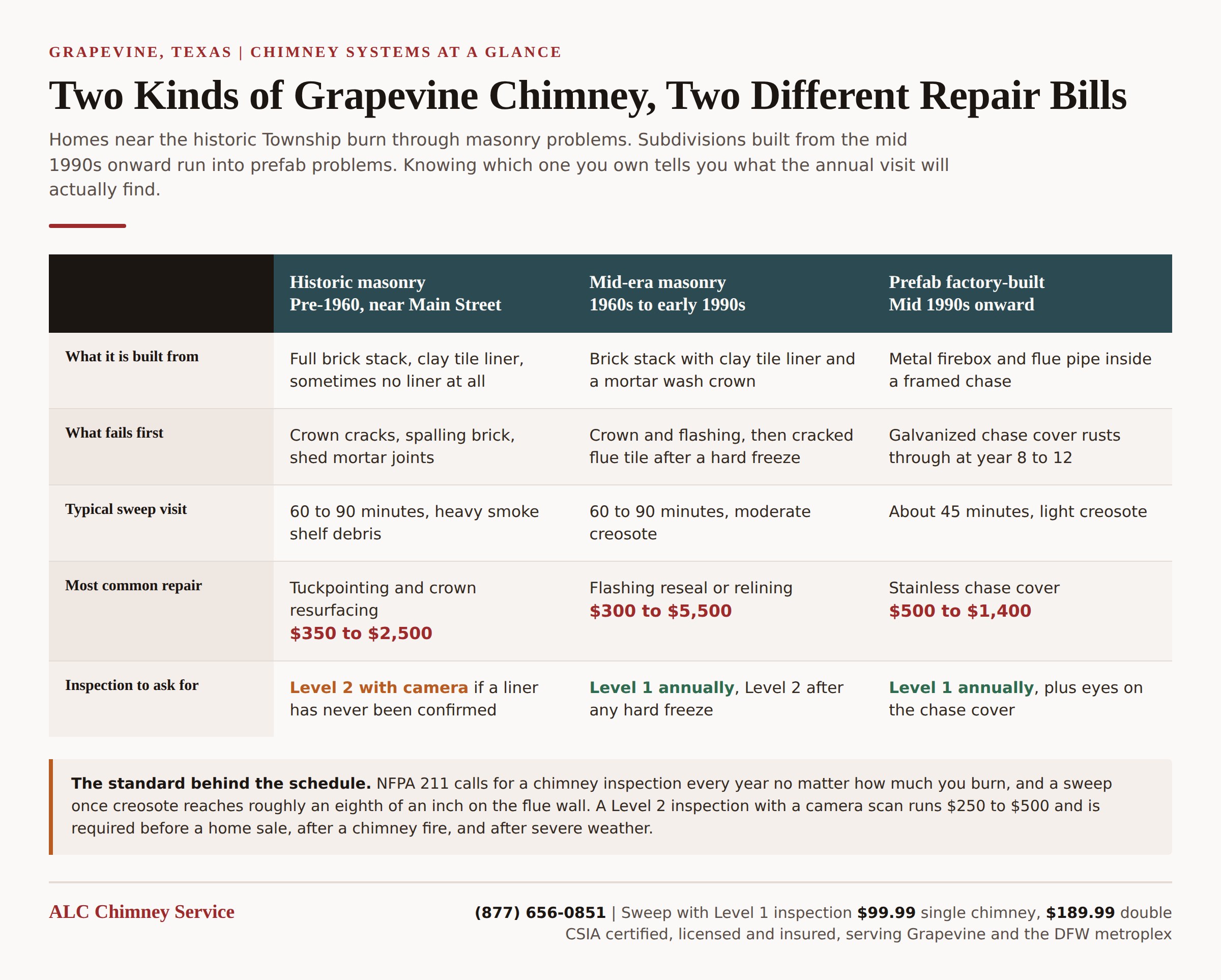
- Grapevine’s housing stock splits in two: masonry chimneys near the historic Township, and factory-built prefab systems in the subdivisions that filled in from the mid 1990s onward.
- Prefab chimneys rarely need heavy sweeping, but their galvanized chase covers routinely rust through by year eight to twelve.
- A Level 2 inspection with a camera scan, $250 to $500, is the correct call before a home sale, after a chimney fire, and after any hard freeze that could have cracked flue tile.
- Late summer and early fall is the fastest time to book in Tarrant County, because the first November cold front triples call volume within days.
How much does a chimney sweep in Grapevine, TX actually cost?
The sweep itself is the predictable part and everything around it is not. At ALC the sweep and Level 1 inspection is $99.99 for one flue and $189.99 for two, and that number does not change based on which Grapevine neighborhood you live in. What changes is what the inspection turns up. Roughly half the Grapevine homes we visit each fall need nothing beyond the cleaning, and the other half get a written finding, usually a cracked crown, a rusted chase cover, or flashing that has pulled away from the brick.
Across the wider Tarrant County market, $150 to $350 is the normal quoted range. Some of that spread is legitimate, since a company running one truck out of Fort Worth has real drive time to Grapevine, and some of it is padding. What to ask on the phone is whether the Level 1 inspection is included and whether you get anything in writing. A sweep without a written inspection is a cleaning rather than a safety check, and it will not satisfy a home inspector or an insurance adjuster. Our chimney inspection service page covers each level.
Why do quotes vary so much between companies?
Equipment carries part of it, because a company with a rotary system and a HEPA vacuum has more invested per truck than one working with a poly brush and a shop vac. Certification carries another part, since CSIA credentials cost money to earn and keep current. The third factor is the business model, and a very low advertised price usually means the revenue is expected to arrive through repairs found during the visit.
What actually happens during a chimney sweep visit?
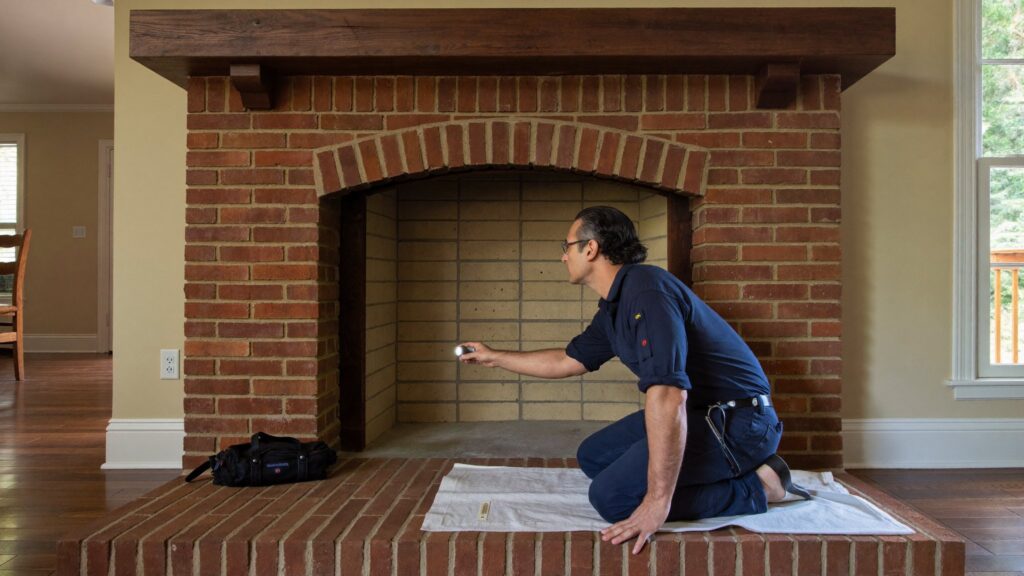
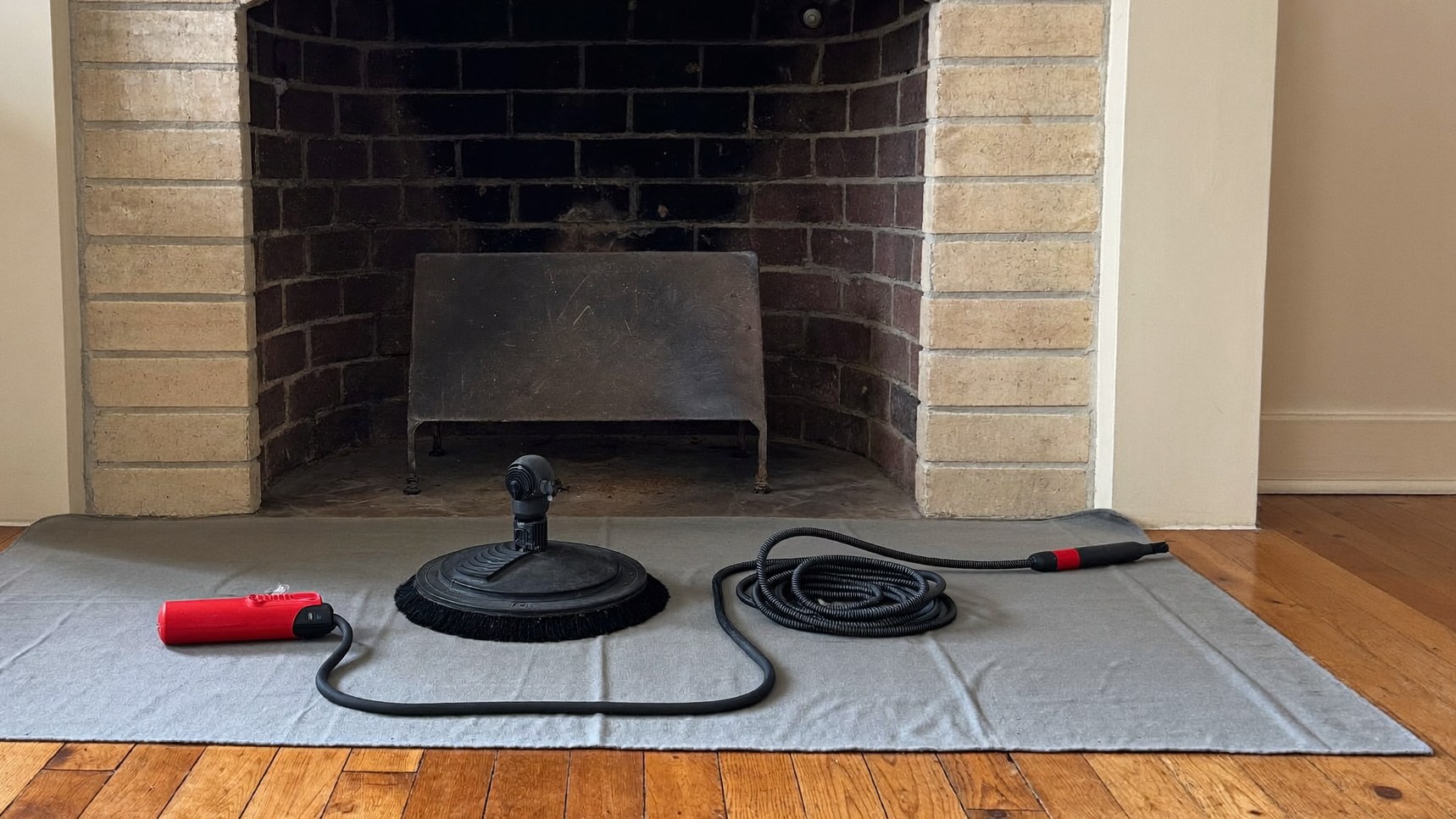
A proper sweep is a contained process that should leave your living room exactly as clean as the technician found it. Drop cloths go down over the hearth first, and a HEPA-rated vacuum runs at the firebox opening for the whole visit to hold dust inside the system. The cleaning works from the bottom up, using flexible rods and a brush sized to the flue, scrubbing the flue walls, the smoke chamber, and the smoke shelf before the debris is vacuumed out of the firebox. On an older chimney near Main Street it is not unusual to pull out a bucket of soot, mortar crumbs, and the occasional bird nest.
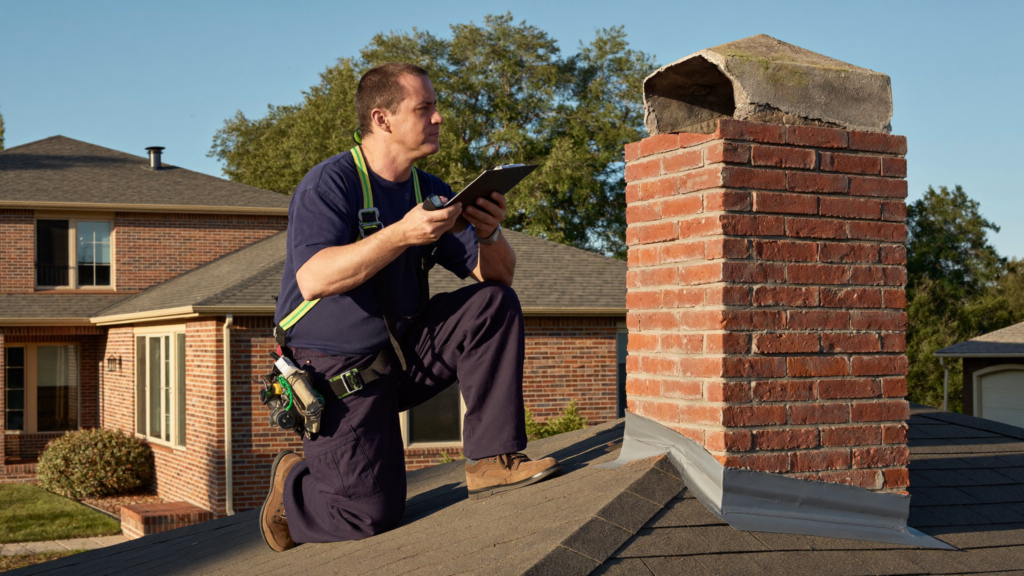
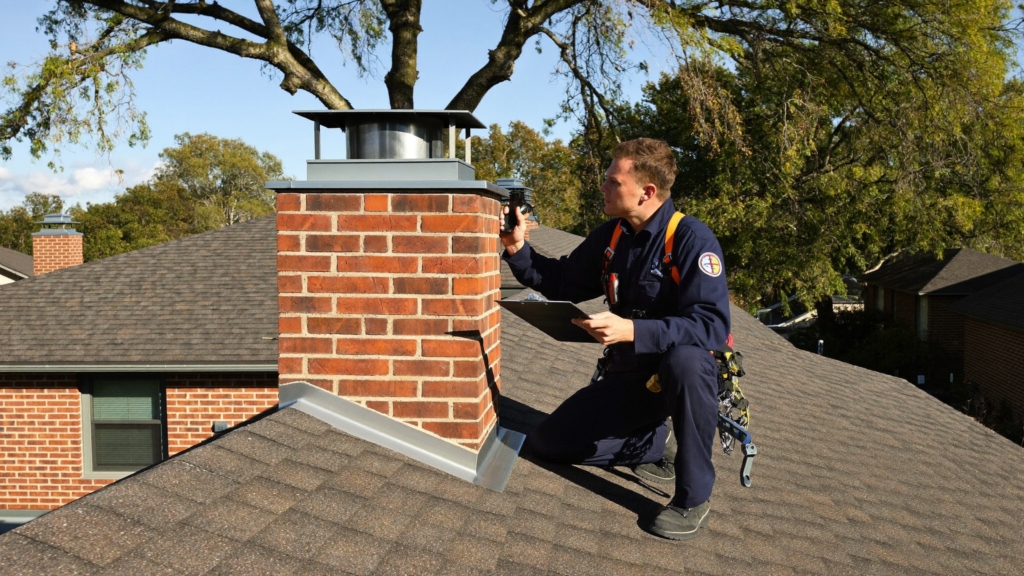
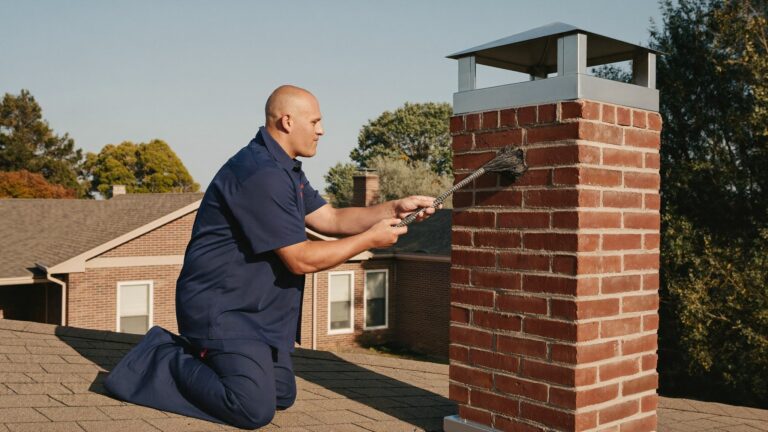
The Level 1 inspection runs alongside the cleaning. The technician checks damper operation, looks at the firebox brick and mortar joints, examines the flue for cracked or missing tile, and goes up on the roof for the crown, the cap, and the flashing. What you should receive at the end is a written summary of each component rather than a verbal all clear at the door.
How long does the visit take?
Budget 60 to 90 minutes for a single masonry flue in normal condition. A prefab system often finishes in 45 minutes, and two flues on the same visit run closer to two hours. Heavy glazed creosote is the exception, because that becomes a treatment job that may need a second appointment after the chemical has had time to work.
How often does a Grapevine chimney need to be swept?
NFPA 211 separates two things homeowners tend to combine. Inspection is annual, every year, whether you burned twenty fires or none. Sweeping is condition-based, triggered when creosote reaches about an eighth of an inch on the flue wall. In practice a Grapevine household that burns most weekends from Thanksgiving through February lands on an annual sweep, while a household that lights three fires a year may go two or three years between cleanings and still needs the yearly inspection.
The reason the inspection cannot be skipped has nothing to do with soot. It is about water, animals, and freeze damage, all of which happen whether or not you use the fireplace. A chimney that sat unused all year can still have a cracked crown, a cap knocked loose by a hailstorm, or chimney swifts nesting in the flue. Gas logs are the case people get wrong most often, since a vented set produces no creosote but does produce water vapor and mild acids that corrode the damper and liner. Our breakdown of how creosote builds up covers the wood-burning side.
When is the best time of year to book?
September and October, without much competition for the title. The first real cold front in North Texas usually arrives in early November, and within about 72 hours every chimney company in Tarrant County goes from same-week availability to a two or three week wait. Booking in late summer leaves room to schedule any repair the inspection finds before you want to use the fireplace.
What makes older Grapevine chimneys different?
The homes in and around the historic Township, along the streets feeding into Main Street, include stock going back to the early and mid twentieth century. Those chimneys were built as full masonry systems, often with clay tile liners and in the oldest cases none at all. A century of thermal cycling is hard on that assembly. Mortar joints shed, clay tiles develop hairline cracks that widen every freeze, and the crown, usually a thin mortar wash rather than a cast slab, lets water into the brick.
What we find most often on those systems is water damage rather than creosote. Brick that absorbs moisture and then freezes begins to spall, meaning the face flakes off, and once spalling starts above the roofline it accelerates because every exposed face soaks up more water than the glazed original did. Catching it early means tuckpointing and waterproofing, while catching it late means rebuilding the stack. If your home predates the 1950s and nobody has confirmed a liner is present, that calls for a Level 2 inspection with a camera before you burn anything in it.
Does a historic home need different repair materials?
Frequently, yes. Older Grapevine masonry was laid with softer lime-based mortar, and repointing it with modern high-strength Portland mortar traps moisture in the brick and makes spalling worse. Matching mortar strength to the original is standard practice, and it is worth asking any contractor whether they intend to do it.
What goes wrong with prefab fireplaces in newer Grapevine subdivisions?
Most Grapevine homes built from the mid 1990s forward, including the neighborhoods around Grapevine Lake and the corridor toward Southlake, use factory-built fireplaces. These are metal firebox units with a metal flue pipe, wrapped in a framed chase finished in siding or thin brick veneer so it reads as masonry from the street. They are safe systems when maintained, and they fail in an entirely different pattern than brick.
The chase cover is the number one issue we find. Builders across DFW installed galvanized steel covers as standard, and galvanized in this climate holds up for roughly eight to twelve years before rust perforates it. Every rainstorm after that sends water inside the chase where it soaks framing lumber, rusts the firebox from behind, and shows up as a ceiling stain. Replacement in stainless runs $500 to $1,400 depending on size and roof access.
Refractory panels are the second recurring finding, since heat cycling cracks the molded panels lining the firebox and exposes the metal shell to direct flame, which is a manufacturer-listed reason to stop using the appliance until it is repaired. Panel replacement lands between $400 and $1,200. A missing cap on the flue pipe is the third, covered on our chimney cap installation and repair page.
Can prefab parts be swapped for generic replacements?
No, and this matters. Factory-built fireplaces are listed and tested as complete systems, so replacement panels, doors, and flue components have to be the parts specified by that manufacturer for that model. Installing a generic panel voids the listing and weakens the homeowner’s insurance position if there is ever a fire.
How does North Texas weather damage a Grapevine chimney?
Freeze-thaw cycling does the first share of the work. Grapevine has no long winter, but it swings across the freezing line repeatedly, and the February 2021 event plus the January 2024 freeze both left visible damage across Tarrant County. Water sitting in a hairline crown crack expands about nine percent when it freezes, widening the crack so it holds more water next time. Hail and straight-line wind do the second share between March and June, knocking caps loose, punching chase covers, and lifting flashing.
Expansive clay soil does the third. Much of Tarrant County sits on clay that swells in spring and shrinks through a dry August, and chimneys are heavy narrow structures on their own footing, so movement shows up as a gap between the chimney and the exterior wall or as stair-step mortar cracking. Sealing the surface does nothing for that. For absorption, a vapor-permeable masonry sealer is the right answer, explained in our guide to chimney waterproofing in North Texas.
Will insurance cover storm damage to my chimney?
Hail impact, wind-lifted flashing, and a cap torn off are frequently covered under the same claim as roof damage, while gradual deterioration generally is not. Documentation decides it, so photographs and a dated inspection soon after the storm matter more than the argument you make months later. We are not adjusters, but a clear report gives you something concrete to file.
These are the findings that show up most often on Grapevine inspection reports, and what each becomes if left alone for a few seasons.
| What the inspection finds | What it becomes if ignored | Typical repair cost |
|---|---|---|
| Hairline cracks in the chimney crown | Water into the brick, spalling, then a stack rebuild above the roofline | $350 to $900 for resurfacing |
| Rusted galvanized chase cover on a prefab | Water inside the chase, rotted framing, rusted firebox shell | $500 to $1,400 in stainless |
| Lifted or corroded flashing | Ceiling and wall staining near the fireplace, drywall damage | $300 to $900 |
| Glazed third degree creosote | Chimney fire risk, cracked flue tile, potential structural fire | $250 to $600 in treatment |
| Cracked clay flue tile | Combustion gases reaching framing, system taken out of service | $2,500 to $5,500 to reline |
| Cracked prefab refractory panels | Direct flame on the metal shell, appliance no longer listed as safe | $400 to $1,200 |
| Missing or damaged chimney cap | Rain, leaves, squirrels and chimney swifts inside the flue | $175 to $600 |
Why Choose ALC Chimney Service in Grapevine?
ALC Chimney Service is a family owned company working across the Dallas and Fort Worth metroplex, and Grapevine sits inside the regular service area, so there are no trip fees here. Our technicians are CSIA certified and the company is licensed and insured. Between the team we have more than 15 years of combined experience and over 10,000 jobs completed across DFW, which in practice means we have already seen whatever your chimney is doing.
The pricing is published rather than negotiated on your doorstep. A sweep with a Level 1 inspection is $99.99 for a single chimney and $189.99 for a double, and the repair inspection is free. We hold a 5.0 rating from more than 172 Google reviews, which reflects what we optimize for, which is finishing a visit without inventing work. Our Grapevine chimney services page lists what we cover here, we run the neighboring cities on the same routes through Southlake and Coppell, and the full range of cleaning work is described on our chimney sweep service page.
Frequently Asked Questions
How much is a chimney sweep in Grapevine, TX?
A single flue sweep with a Level 1 inspection is $99.99 at ALC Chimney Service, and $189.99 covers a home with two chimneys or two flues. Across Tarrant County, expect quotes between $150 and $350 for comparable work. Anything advertised under $75 is normally a lead generation price, and the final invoice looks very different once the technician has been inside the system.
How often should I have my chimney swept in Grapevine?
NFPA 211 requires an inspection annually and a sweep whenever creosote reaches roughly an eighth of an inch. For a household that burns most weekends through the winter, that means a yearly sweep. For occasional users the sweep may be every two or three years while the inspection stays annual, because water damage, storm damage, and animal entry happen regardless of use.
Do gas fireplaces in Grapevine need chimney service?
Yes, annually. Gas does not create creosote, but it does produce water vapor and mildly acidic condensate that corrode dampers, flue liners, and metal prefab components. Vented gas sets also need the flue kept clear of nests and debris. The visit is faster than a wood-burning sweep, and it still needs to happen every year.
How do I know if my Grapevine home has a prefab or masonry fireplace?
Look up inside the firebox with a flashlight. A masonry system shows firebrick with visible mortar joints and a clay tile flue above it. A prefab shows smooth molded refractory panels, usually with a metal frame around the opening and a round metal flue pipe. Homes built in Grapevine after roughly 1995 are mostly prefab, and homes near the historic Township are usually masonry.
Can a chimney sweep fix my chimney the same day?
Small items yes, structural items no. Cap installation, minor sealing, and damper adjustment are often handled on the spot. Crown resurfacing, chase cover fabrication, tuckpointing, and relining are separately scheduled, since stainless covers are cut to your chase dimensions and masonry work needs the right weather window. Our repair inspection is free, so pricing a second visit costs nothing.
What is a Level 2 inspection and do I need one to sell my house?
A Level 2 adds a video camera scan of the entire flue plus accessible areas where the chimney passes through the structure, and it costs $250 to $500. NFPA 211 calls for one on any property sale, after a chimney fire, after severe weather, and when the fuel type changes. For a Grapevine listing it is worth doing before you go under contract rather than during the option period.
Do you charge extra to come out to Grapevine?
No. Grapevine is inside our regular service area and there are no trip fees. We run Grapevine, Southlake, Colleyville, and Coppell on the same routes, which is why we can usually offer a tighter appointment window here than a company dispatching from farther out.
If your fireplace has been sitting untouched since last winter, now is the quiet part of the calendar to deal with it. A sweep with a Level 1 inspection is $99.99 for a single chimney and $189.99 for a double, the repair inspection is free, and there is no trip fee anywhere in Grapevine. Call ALC Chimney Service at (877) 656-0851 or book an appointment online before the November rush starts.
Find our chimney safety tips faster on Google